Healthcare SEO, AI SEO, and Web Design Services in Seattle, WA
Healthcare marketing for the Seattle practices squeezed between the systems: independent specialists on First Hill and Capitol Hill, DPC clinics serving South Lake Union tech workers, and multilingual clinics in Beacon Hill and Rainier Valley.

See what you're missing in Seattle, WA.
Send us your site. We'll pull your Map Pack positions, organic rankings, GBP health, and site speed for Seattle doctor queries, then send the numbers back inside 24 hours. No call required.
Fifteen minutes with a senior strategist.
Tell us what's going on with your Seattle, WA doctor market. We'll tell you what we'd actually do, what it would cost, and whether we think the project is a fit. No pitch deck.

See what you're missing in Seattle, WA.
Send us your site. We'll pull your Map Pack positions, organic rankings, GBP health, and site speed for Seattle doctor queries, then send the numbers back inside 24 hours. No call required. No sales pitch.
2 mo
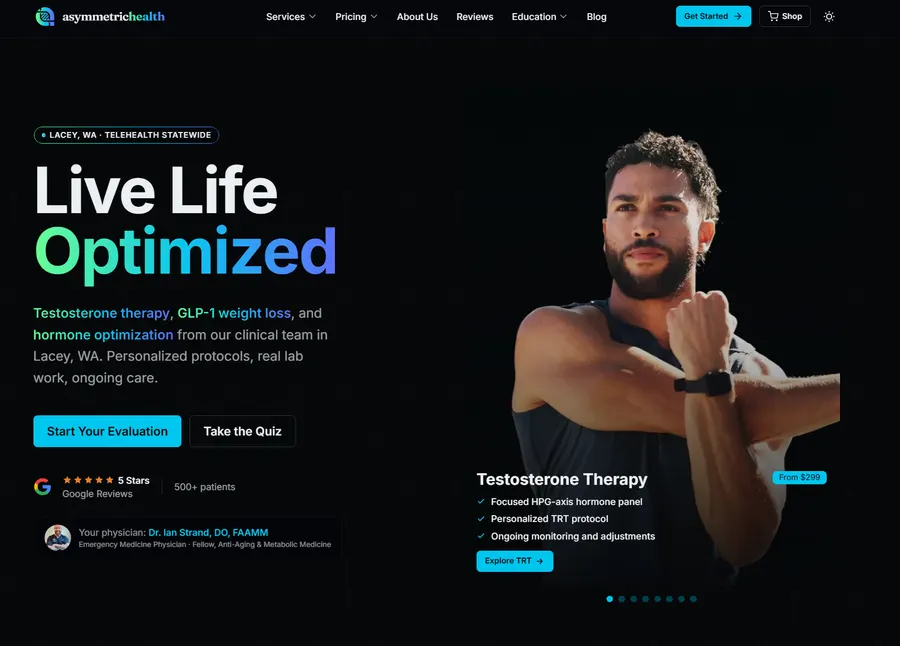
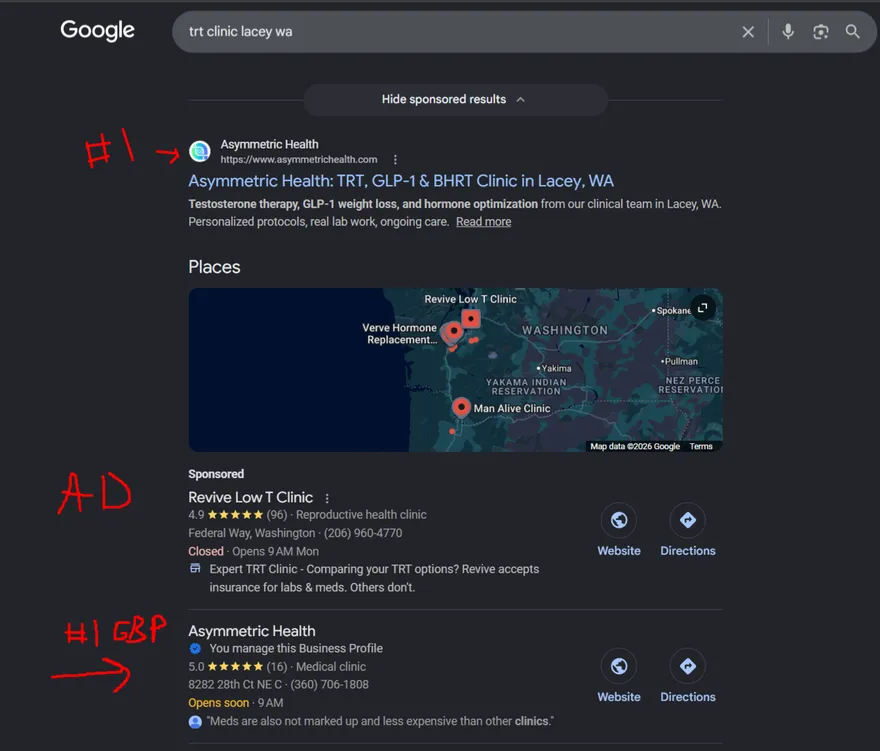
From launch to the top of organic for our DPC client Asymmetric Health
5.0★
Google rating that put Asymmetric Health at the top of the local pack
755,078
Seattle pop. · King County
27
Years of SEO · since 1999
How does an independent Seattle practice compete with UW Medicine, Swedish, Virginia Mason Franciscan Health, Kaiser, and Amazon's One Medical?
- Seattle population
- 755,078
- King County
- Top services
- Dermatology + cosmetic dermatology
- Direct primary care + concierge medicine
- Search volume
- 1,350/mo
- 35 city-modified queries
- Map Pack timeline
- 60-90 days
- For properly-built GBPs
Seattle is the hardest city in Washington for an independent practice to get found. First Hill stacks Swedish, Virginia Mason, and Harborview (the region's Level 1 trauma center) within a dozen blocks. UW Medicine runs two more hospitals plus a citywide clinic network. Kaiser Permanente Washington keeps a large member base locked in. Their decades-old domains own the head terms.
What Makes Seattle, WA Different
Top services
-
Dermatology + cosmetic dermatology
System dermatology departments book out months, and derm patients comparison shop. Independent practices with condition-level pages and before-and-after depth capture the overflow the systems create.
-
Direct primary care + concierge medicine
Seattle's tech workforce is the natural DPC patient: HSA-funded, frustrated with 15-minute system visits, already paying for One Medical. Clinics that explain pricing and access clearly convert this demand.
-
Orthopedics + sports medicine
Runners, cyclists, climbers, and crossfitters produce year-round injury searches. UW takes the head terms; independents win on procedure specificity and map pack position near where patients train.
-
Physical therapy
Washington allows direct access to PT, so patients self-refer straight from Google. Neighborhood PT queries convert exceptionally well, and most clinics chase them with three-page websites.
-
Med spa adjacent clinic services
Injectables, laser, and aesthetic demand concentrates in Capitol Hill, Ballard, and downtown. Cash-pay, review-driven, and decided in the map pack, so GBP discipline pays most here.
Seattle marketing snapshot
- Region
- Puget Sound Metro
- County
- King County
- Population
- 755,078
- PPC competitive level
- high
- Surrounding cities served
- 6
The hospital geography defines the market. First Hill (Pill Hill on any older map) holds Swedish, Virginia Mason, and Harborview. UW Medical Center sits at Montlake with a second campus in Northgate, Seattle Children's anchors Laurelhurst, Fred Hutchinson runs its clinical campus in South Lake Union, and Kaiser keeps the Capitol Hill campus it inherited from Group Health.
Two consolidation waves matter. Virginia Mason merged with CHI Franciscan in 2021 to form Virginia Mason Franciscan Health, and Optum bought The Polyclinic, the city's big multispecialty group. Each merger pushed more Seattle physicians into system employment: fewer independent competitors, but the survivors face employers with essentially unlimited marketing budgets.
Patient demand splits by neighborhood in ways the systems are too big to exploit. Capitol Hill, Ballard, and Fremont generate heavy cash-adjacent demand: dermatology, aesthetics, mental health, DPC memberships. South Lake Union produces daytime searches from tech employees on Premera and Aetna PPO plans with HSA balances they actually spend. West Seattle behaves like a small town with its own search patterns.
Beacon Hill, Columbia City, and Rainier Valley hold Vietnamese, Chinese, Somali, Spanish, and Amharic speaking communities whose healthcare searches happen in those languages. Almost no practice builds content for them.
Ad costs on Seattle healthcare queries run above the national average, which tilts the math toward organic. The systems own the head terms, but AI Overviews and the map pack reward specificity: Google answers "best dermatologist in Seattle for acne scars" by citing practices with real service depth, named physicians, and consistent reviews, not hospital brochureware.
Questions Seattle Doctors Ask Before Signing On
On the organic head terms, mostly no, and any agency that promises otherwise is lying to you. UW Medicine and Swedish have decades-old domains, thousands of indexed pages, and news coverage feeding them links every week. "Cardiologist Seattle" belongs to them.
But that is not where patients pick a doctor. The map pack ranks individual locations, and hospital systems run their profiles like an afterthought: generic descriptions, unanswered reviews, departments cannibalizing each other.
Neighborhood and condition searches ("knee specialist Ballard", "same day dermatology Capitol Hill") are winnable in 60 to 90 days with a clean Google Business Profile and service pages that say something. AI Overviews follow the same logic. That is the fight worth funding, and the one we build the program around.
One Medical sells access: an app, same-day slots, clinics near the office towers. It does not sell continuity. Its patients see whoever is available, and the ones who want an ongoing relationship with a physician age out of the model. That churn is an acquisition channel if your site is built to catch it.
Practically: match the booking experience (online scheduling, visible availability, fast mobile load) so you do not lose on convenience, then win on what One Medical cannot say: a named doctor patients keep, panel sizes, direct access. Searches like "DPC Seattle" have grown every year since the acquisition.
The self-referral specialties. Dermatology, physical therapy (direct access in Washington), med spa adjacent services, DPC and concierge primary care, mental health. The patient finds the clinic on Google, books directly, and shows up. No referral gatekeeper sits between the ranking and the revenue, so map pack movement converts inside the first quarter.
Referral-dependent specialties still benefit, but the content works two audiences: patients researching a procedure and referring physicians checking whether you are credible. Slower compounding, higher revenue per patient. We set expectations by specialty up front, because a derm timeline and a spine-surgery timeline are not the same conversation.
Let us take a look at Seattle, WA.
Tell us your service area, your services, and the mix of SEO, AI Search, Web Design, and PPC you're considering. We'll scope it against the actual Seattle market.