Medical Website Design built to load fast, book patients, and get cited by AI search.
Medical website design at Savo Group is hand-coded websites built for doctors, clinics, and medical practices: a plain-English page for every treatment, pricing in the open, booking wired into your practice systems, and content structured so Google's AI Overview cites you by name. No WordPress, no Elementor, no JavaScript-rendering traps.

See where your practice stands.
Send us your site. We'll pull your map pack positions, organic rankings, Google Business Profile health, and the AI answers patients in your market already see, then send the numbers back inside 24 hours. No call required.
What does a medical practice website need to book patients, rank, and get cited by AI?
An effective medical practice website in 2026 is fast on a phone, bookable without a phone call, priced in the open, accessible to every patient, and built on hand-coded HTML rather than a page builder. Google's research shows mobile bounce rates climb 32 percent as load time moves from 1 to 3 seconds, and a patient comparing three clinics does not wait for the slow one.
Most healthcare website design fails that baseline the same way: a WordPress page builder on a multi-purpose theme, one vague "Services" page covering fourteen treatments, "call for pricing" everywhere, and an intake pixel quietly sending patient data to an ad network.
The practices winning search do the opposite. Every treatment gets its own plain-English page. Pricing is published where the model allows. Booking connects to the practice systems instead of dead-ending in a contact form.
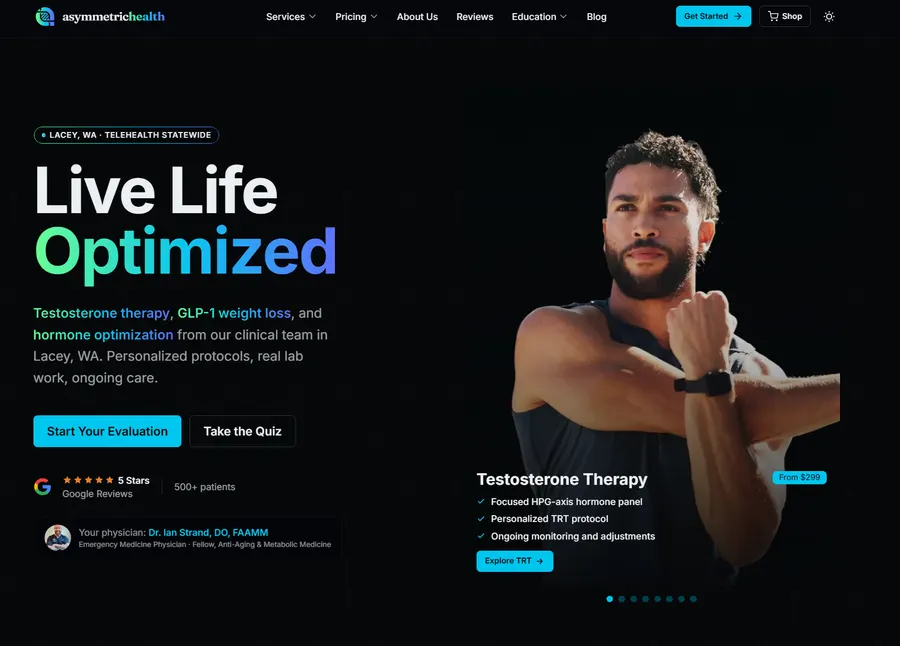
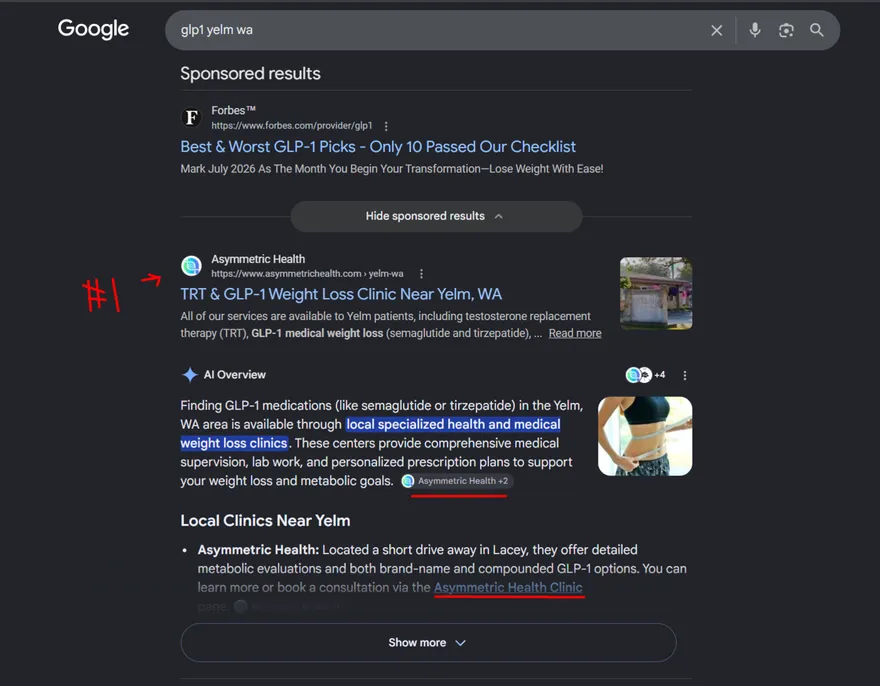
That is how we built Asymmetric Health's site, and the result was #1 organic in 2 months, #1 positions across its priority treatment searches, and cited first by Google's AI Overview, by name, with pricing. The website did not do that alone (the healthcare SEO program compounds on top of it), but none of it happens on a slow page-builder site.
The website is the foundation every other marketing dollar compounds on.
SEO ranks the website. Google Ads sends traffic to the website. AI Overviews cite the website. If the foundation is slow, unbookable, or invisible to crawlers, every dollar spent on top of it underperforms. For a medical practice there is a second layer: the website is also where compliance mistakes happen, quietly, in forms and tracking pixels.
AI Overview citations
4Google's AI recommends the clinic by name, with pricing.
Most medical practice websites are built on WordPress page builders. Bloated themes, stacked plugins, and client-side rendering produce the slow, hard-to-index sites that AI engines skip and Google rates poorly under Core Web Vitals. Hand-coded medical website design avoids that entire failure mode from day one.
"Call for pricing" is costing you patients. When one clinic publishes what an evaluation costs and the other hides it behind a phone call, patients pick the one that respected their time. AI engines do the same: they cite pages with concrete, extractable answers. Pricing transparency wins twice.
You are one of 38,700 monthly searches for healthcare marketing help.
Pulled from the Semrush US database. This is what doctors, clinic owners, and practice managers search when they go looking for marketing and website help, and what a single click on those searches costs in Google Ads. We publish our data because we think you should see the same numbers we do.
| # | Search query | Monthly volume |
|---|---|---|
| 1 | healthcare marketing | 8,100 |
| 2 | healthcare marketing agency | 5,400 |
| 3 | medical marketing agency | 4,400 |
| 4 | healthcare seo | 4,400 |
| 5 | medical seo | 4,400 |
| 6 | healthcare seo agency | 3,600 |
| 7 | healthcare digital marketing agency | 3,600 |
| 8 | medical practice marketing | 2,400 |
| 9 | medical website design | 2,400 |
Difficulty is Semrush keyword difficulty, 0 to 100. Source: Semrush US database, fetched July 10, 2026. The same discipline applies to your patients' searches: every treatment, condition, and city query in your market maps to a page on a properly built medical practice website.
Speed. Conversion. Indexability.
Websites for doctors have three jobs. Show up fast on a phone. Turn a researching patient into a booked appointment. Get extracted cleanly by Google's crawler and AI engines. Each one is engineered into the build, not patched on after.
Speed
Sub-2-second mobile load on day one.
Google's recommended Core Web Vitals ranges. Every build ships inside them, tuned for fast mobile load from launch day.
How we get there
- Static-site generation, no runtime CMS
- WebP images with explicit dimensions
- Zero third-party scripts on the critical path
- Lazy loading below the fold
Mobile bounce rate jumps +32% as load time moves from 1 to 3 seconds. Patients in discomfort are not patient.
Conversion
Built for how patients actually decide.
Online booking and click-to-call on every page, prominent on mobile.
What's on every page
- Online booking plus sticky click-to-call on mobile
- A plain-English page for every treatment and service
- Transparent pricing where the practice model allows
- Trust signals up front: credentials, reviews, real photos
On the Asymmetric Health build, buying an evaluation creates the patient record in their Hint EHR. No separate intake step to abandon.
Indexability
Clean HTML for Google's crawler and AI extractors.
<script type="application/ld+json">
"@type": "MedicalClinic",
"name": "Asymmetric Health",
"medicalSpecialty": ...
"priceRange": ...
</script>
Built into every page
- Server-rendered HTML, no JS render traps
- MedicalClinic, Physician, Service, FAQ schema
- Declarative answers AI engines can quote
- Clean URLs, sitemap, canonical tags
A page builder rendering content client-side is largely invisible to AI extraction. Hand-coded medical websites are the opposite. How AI search optimization works for doctors.
A slow WordPress site, rebuilt by hand. Two months later, #1.
Asymmetric Health is a physician-led Direct Primary Care clinic specializing in TRT, GLP-1-assisted medical weight loss, and BHRT in Lacey, WA, serving 500+ patients. When the engagement started in 2026, they had a problem a lot of independent practices will recognize: a slow WordPress site that said almost nothing about why the clinic is different, while VC-funded national telehealth companies picked off their local patients one search at a time.
We rebuilt it as a hand-coded site. No WordPress, no page builder. Every treatment got its own plain-English page instead of one vague services list. Pricing went up on the site in the open.
And the booking flow got connected to the systems the clinic already runs on: buying an evaluation on the website creates the patient's record in their Hint EHR, so there is no separate intake step for a new patient to abandon.
Then the local SEO program went to work on top of that foundation. Two months after launch, the clinic was #1 organic for its priority searches.
It now holds top organic rankings across GLP-1, TRT, peptide therapy, and ED searches in Lacey and Yelm, has been cited 4 times by Google's AI Overview by name and with pricing, and sits at the top of the Olympia local pack at 5.0 stars for TRT and BHRT, ahead of clinics physically located in Olympia.
Every treatment, its own page
A patient researching one specific treatment lands on a page about that treatment, written in plain English. Not a services list with fourteen bullet points and no answers.
Pricing in the open
Published pricing converts the comparison shopper and feeds the AI engines. Google's AI Overview cites the clinic with its pricing because the pricing is on the site to cite.
Booking that creates the chart
The Hint EHR integration means a purchased evaluation is already a patient record. No callback, no paper intake, no drop-off between paying and becoming a patient.
The WordPress page-builder problem.
Most medical practice websites are built on WordPress with a page builder (Elementor, Divi, WPBakery) layered on a multi-purpose theme, usually by a vendor who builds the same site for dentists, lawyers, and restaurants. The result is convenient to spin up and expensive to live with. Here is what we typically find when we review one.
Typical WordPress practice site
- × 60+ HTTP requests on initial load
- × Hundreds of KB of unused CSS and JavaScript
- × Mobile PageSpeed score in the 30 to 60 range
- × Client-side rendered content invisible to AI
- × One "Services" page for fourteen treatments
- × Form plugins and ad pixels nobody vetted for PHI
- × Plugin update treadmill, periodic breakage
A hand-coded Savo Group site
- ✓ Static HTML, served from a global edge CDN
- ✓ 80 to 90% smaller page weight
- ✓ Tuned for fast mobile load from launch day
- ✓ Server-rendered HTML, fully indexable, AI-readable
- ✓ A dedicated page for every treatment and service
- ✓ Forms and analytics reviewed so no PHI leaks out
- ✓ Portable codebase, you own it, you can move it
The complete medical website design build.
Custom hand-coded build
Every medical practice website is hand-coded in Astro and Tailwind, not assembled in a page builder. Static HTML output, deployed to Cloudflare's global edge network, tuned for fast mobile load from launch day.
A page for every treatment and service
Each treatment, procedure, and service gets its own page written in plain English, structured around the searches patients actually run before booking. This is the single biggest content gap on most medical practice websites, and the easiest to fix.
Transparent pricing pages
Where your practice model allows it, pricing goes on the site. Pricing pages beat call-for-pricing on conversion, and they are what AI engines quote when they recommend a practice. Insurance-driven models publish what they can: self-pay rates, memberships, what a first visit involves.
Online booking and intake integration
Booking wired into the systems your practice already runs on, so a new patient does not dead-end in a contact form. On the Asymmetric Health build, buying an evaluation creates the patient record in their Hint EHR with no separate intake step to abandon.
HIPAA-conscious forms and analytics
Forms collect the minimum the front desk needs. Nothing a patient types goes into analytics, and no third-party ad pixel fires on pages where patients describe their situation. We treat PHI leakage into marketing tools as a hard line, because regulators do.
ADA accessibility, built in
Semantic HTML, real heading hierarchy, color contrast, keyboard navigation, labeled forms, and alt text on every image. Healthcare sites are frequent targets of accessibility complaints; ours are built to the standard, not patched with an overlay widget.
Schema markup, end-to-end
MedicalClinic, Physician, Service, FAQPage, and BreadcrumbList schema applied consistently across the site and validated on every build, not bolted on with a plugin. This is how Google and AI engines understand who you are and what you treat.
Mobile-first conversion design
Sticky click-to-call and book-appointment buttons on mobile, credentials and reviews above the fold, and page layouts built for the patient who is comparing three practices on a phone in a parking lot.
Indexability and technical SEO
Clean canonical tags, XML sitemap generated on every build, robots.txt configured for AI crawlers, and Core Web Vitals inside Google's recommended ranges. The site is ready for the SEO program the day it launches.
Launch, monitoring, and iteration
Search Console verified, sitemap submitted, indexing watched, Core Web Vitals tracked. Post-launch we rework the pages that underperform against real booking data. You own the code, the content, and the domain throughout.
One engagement, measured in rankings and bookings.
Asymmetric Health is the working example of how this engagement runs for a medical practice: website rebuild first, healthcare SEO program compounding on top, everything measured against searches that produce patients. The engagement started in 2026 and is active today.
The full engagement
Website plus marketing, working together.
Website
You're reading this guide
SEO →
#1 organic rankings across its priority searches
PPC →
Fills the schedule today
Time to #1
2 moWebsite rebuild plus a healthcare SEO program, from launch to #1 organic in 60 days
Organic rankings
#1The clinic's priority TRT, GLP-1, and peptide searches across its home market
AI Overview citation
1stGoogle's AI cites the clinic first, by name, with its pricing
Google map pack
Top 3Dominating the local pack at 5.0 stars, ahead of clinics based in Olympia
"Best business decision I've ever made! The calls started coming in left and right. I guarantee you will make your ROI in no time and the team is very responsive and helpful."
Tanner C.
Savo Group client · Google review
A defined process. No surprises.
Discovery & strategy
We map your treatments, your locations, your patient flows (new-patient booking, comparison shopping, condition research), and the competitive picture in your market. We also flag the compliance constraints up front: what your forms can collect, what your analytics can see, what your specialty can claim. The blueprint everything else follows.
Design & content
Custom design that looks like your practice, with real photography of your clinic and team instead of stock physicians in white coats. Every treatment and service gets its own plain-English page, drafted around the searches patients actually run. Pricing pages where your model allows it.
Hand-coded build
Static-site build using Astro and Tailwind. No WordPress, no page builder, no JavaScript-rendering traps. Online booking and intake integration wired in where your practice systems support it. Every page tuned for fast mobile load from launch day.
Schema, accessibility, launch
MedicalClinic, Physician, Service, and FAQ schema on every applicable page. An ADA accessibility pass: semantic HTML, contrast, keyboard navigation, screen-reader labels. A form and analytics review so nothing patient-identifiable leaks into tracking. Then Search Console verification, sitemap submission, and indexability QA before go-live.
Iterate against real data
Post-launch we watch Core Web Vitals, ranking trends, booking behavior, and which pages patients actually convert on. Pages that underperform get reworked. The site improves quarter over quarter instead of quietly rotting.
What a medical practice website costs.
Website builds start at $3,000 and scale with the engagement: how many treatments need their own page, how many locations, whether booking and EHR integration is in scope, whether photography is included.
Two ways to pay. Pay for the build upfront with a 6-month engagement term, or amortize the build across 12 months as part of the program with a 12-month term. Same site either way; the second option just spreads the cash flow.
Ongoing marketing is one all-in-one monthly fee covering local SEO, organic SEO, AI search optimization, review generation, and reporting tied to actual bookings. Other agencies invoice each of those separately. We think the nickel-and-dime model is a big part of why doctors distrust marketing agencies, so we refuse to run it.
Get a scoped quoteThe complete healthcare marketing stack.
A fast, indexable medical practice website is the foundation. SEO and AI search optimization compound on top of it; PPC fills the schedule while the rest is building.
SEO for Doctors
Map Pack, organic, and AI answers. The compounding patient engine that runs on top of the site, with local SEO doing the neighborhood work.
See healthcare SEOAI Search Optimization
Get cited in Google AI Overviews, ChatGPT, and Perplexity when patients ask who to see. Hand-coded sites are AI-readable by default.
See AI SEO for doctorsGoogle Ads / PPC
Fill the schedule today while SEO compounds. Healthcare marketing clicks run $11 to $37 in this cluster; the landing page had better convert them.
See the PPC approachQuestions doctors and practice managers ask before a build.
A great medical practice website in 2026 does seven things at once:
- Loads fast on a phone
- Lets a patient book without calling
- Gives every treatment its own plain-English page
- Publishes pricing where the practice model allows it
- Meets ADA accessibility standards
- Keeps patient-identifiable data out of analytics and ad pixels
- Carries the schema markup that lets Google and AI engines understand what the practice does
Most practice websites fail on four or five of those at once, which is why the ones that get all of them right pull ahead so quickly.
Under 2 seconds on mobile, ideally under 1.5. Google's own research shows mobile bounce rates increase 32 percent as load time goes from 1 to 3 seconds, and 90 percent as it goes from 1 to 5. A patient comparing three clinics from a search result does not wait for the slow one.
Every site we build ships as static HTML tuned for fast mobile load from launch day, and you can verify any site's numbers yourself at pagespeed.web.dev. If an agency will not show you real Core Web Vitals for the sites they have built, that tells you something.
Page builders are convenient to spin up and expensive to live with. The typical page-builder site loads 60+ requests, ships hundreds of kilobytes of CSS and JavaScript it never uses, and renders content client-side, which means slow load times, weak Core Web Vitals, and content that AI engines struggle to extract.
Most of the slow medical practice websites we review are running Elementor, Divi, or WPBakery on a bloated multi-purpose theme.
We hand-code every site in Astro. The output is static HTML, CSS, and minimal JavaScript. Page weight is typically 80 to 90 percent smaller than a WordPress equivalent, with no plugin update treadmill, no theme conflicts, and no caching plugin to babysit. Your site loads fast on day one and stays fast.
Yes, when your practice systems support it. This is where most medical websites quietly lose patients: the site collects a form, the front desk calls back, the patient fills out intake paperwork later, and somewhere in that chain a percentage of them give up.
On the Asymmetric Health build, buying an evaluation on the website creates the patient's record in their Hint EHR through the Hint integration. There is no separate intake step to abandon. The patient pays, the chart exists, the clinic follows up. Not every EHR exposes that kind of integration, but when yours does, we wire it in.
If your model allows it, yes. "Call for pricing" made sense when the alternative was a competitor's phone number. Now the alternative is a competitor's pricing page, and patients pick the practice that respected their time. Transparent pricing pages convert better, and they get cited: Google's AI Overview recommends Asymmetric Health by name with pricing, in part because the pricing is right there on the site to cite.
Insurance-driven practices have less room here, but there is almost always something to publish: self-pay rates, membership pricing, what a first visit involves. Publish what you can and say plainly what depends on coverage.
The marketing site should not be where protected health information lives, so we design it to collect the minimum. Forms ask for what the front desk actually needs and nothing that has to be treated as PHI in transit through marketing tools.
Nothing a patient types goes into analytics, and no third-party ad pixel fires on the pages where patients describe their situation. Regulators have gone after health systems for exactly that pattern, so we treat it as a hard line, not a nice-to-have.
Anything genuinely clinical (intake, records, messaging) belongs in your EHR or patient portal, and the site hands off to those systems cleanly.
More than for almost any other industry. Medical practices serve patients with low vision, motor impairments, and screen readers as a matter of course, and healthcare websites are a frequent target of ADA demand letters.
Accessibility on our builds is structural, not a plugin overlay: semantic HTML, real heading hierarchy, sufficient color contrast, keyboard navigation, labeled forms, and alt text on every image. The same structure that helps a screen reader also helps Google and AI engines parse the page, so the work compounds.
The website makes ranking possible; the SEO work makes it happen. We build the site with fast load times, clean indexable HTML, schema, and proper internal linking so it is ready to rank, then the SEO program does the ongoing work: content depth, citations, Google Business Profile, reviews. See how healthcare SEO works and what local SEO does for a practice.
For calibration: Asymmetric Health went from a fresh rebuild to top-ranked organically in 2 months, holds top organic rankings across its priority treatment searches, and sits at the top of the Olympia local pack at 5.0 stars for TRT and BHRT. That took the website and the SEO program working together, not the website alone.
Website builds start at $3,000 and scale with the size of the engagement: how many treatments need their own page, how many locations, whether booking and EHR integration is in scope, whether photography is included. Two ways to pay: pay for the build upfront with a 6-month engagement term, or amortize the build across 12 months as part of the program with a 12-month term.
Ongoing marketing is one all-in-one monthly fee that covers local SEO, organic SEO, AI search optimization, review generation, and reporting tied to actual bookings. A lot of agencies invoice each of those as its own line item. We think that nickel-and-dime model is why doctors distrust marketing agencies, so we do not run it.
Yes. The code, the content, and the domain are yours. We host on Cloudflare (fast, inexpensive, globally distributed), but the codebase is portable static HTML, and if you ever wanted to move it, we would hand it over. No proprietary CMS lock-in, no "you can never leave" pricing model. You paid for the site; it is yours.
A typical build runs 6 to 10 weeks from kickoff to launch. Discovery and strategy take 1 to 2 weeks, design and content 2 to 3, and the hand-coded build with schema, integrations, accessibility, and pre-launch QA takes 3 to 5. A single-location practice with a short treatment list moves faster; a multi-location group with booking integration takes the full window.
Sources & data
- Semrush US database: keyword volume, keyword difficulty, and CPC for the healthcare marketing and medical website design keyword set on this page. Fetched July 10, 2026.
- Google web.dev and PageSpeed Insights documentation: page speed and bounce-rate research (32% bounce increase from 1 to 3 second mobile load) and Core Web Vitals thresholds. web.dev/articles/why-speed-matters · pagespeed.web.dev
- Asymmetric Health case study: the website rebuild, Hint EHR integration, and healthcare SEO results cited on this page (2 months to #1 organic, #1 organic rankings across its priority searches, first-position AI Overview citations, #1 Olympia local pack at 5.0 stars). savogroup.com/project/asymmetric-health
Website Design for Doctors · Nationwide
We work with doctors nationwide. The cities below are markets where we run a dedicated local website design program with hand-written content, real Semrush keyword data, and city-specific FAQs. Your city not listed? We'll scope a website design program against your specific market when you reach out.
Don't see your city? We work with doctors in every state. Get a free doctor website design report on your business and your local market.
Get a free Website Design reportReady for a medical practice website that actually performs?
Start with a free healthcare SEO Report: your site speed, schema coverage, treatment-page gaps, and where patient bookings are leaking. We send back what we would actually change before we ever scope a redesign.