AI SEO for Doctors: when patients ask AI, your practice gets named.
AI SEO for doctors is the work of getting your practice cited by name in Google AI Overview, ChatGPT Search, Perplexity, and Bing Copilot when a patient asks "who is the best [specialty] near me" or "how much does [treatment] cost in [city]". We build the schema, the extractable content, and the physician-credential signals those engines require before they'll recommend a medical practice.


See where your practice stands.
Send us your site. We'll pull your map pack positions, organic rankings, Google Business Profile health, and the AI answers patients in your market already see, then send the numbers back inside 24 hours. No call required.
What's actually different about ranking in AI search vs traditional Google search for a medical practice?
AI engines read the same web traditional SEO targets, but healthcare gets a stricter version of the rules. Because medical queries are YMYL content (Google's term for topics where a bad answer causes real harm), AI engines demand verifiable physician authorship, credential and license signals, consistent name-address-phone data, and claims that trace to a source before they'll name a practice.
Backlink counts matter less than they do in classic ranking. Extractable facts matter more.
The patient behavior driving this is simple: people now ask AI "who is the best endocrinologist near me" and "how much does semaglutide cost per month in my city" instead of scrolling ten blue links.
Hospital systems dominate the generic educational answers. But when the question turns into a decision (who, where, how much, how soon), the AI recommends specific local clinics, provided the clinic's site hands it the facts: services, pricing, location, availability.
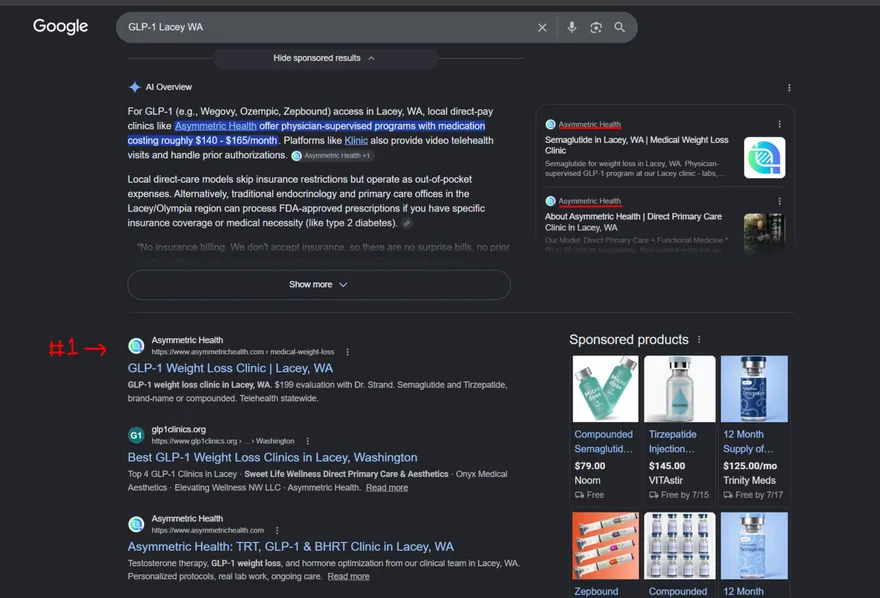
That's the whole design principle behind healthcare AI search optimization as we practice it: one page, built once, that ranks in Google organic results AND gets quoted by Google AI Overview, ChatGPT Search, and Perplexity. Asymmetric Health, a physician-led clinic in Lacey, WA, is the working proof: 2 months to #1 organic, #1 positions, and Google AI Overview citations that name the clinic first, with its address and pricing.
Patients are already asking AI which doctor to book.
Google AI Overview rolled out broadly in May 2024. ChatGPT Search shipped later that year. The queries have changed shape too: less "endocrinologist" and more "who treats low testosterone near me and what does it cost". The practices named inside those AI answers take the bookings. Everyone else is a footnote that didn't make the cut.
Asymmetric Health AI Overview citations
4Searches where Google's AI recommends the clinic by name, with address and pricing.
Time to #1 organic
2 moRebuilt site plus healthcare SEO program, from launch to #1 organic.
Google AI Overview launch
May 2024Broad US rollout, now expanding across treatment and cost queries. blog.google
"Healthcare seo" searches
4,400/moUS monthly searches (Semrush). Other practices are researching this right now.
Hospital systems own the generic answers. They leave the local ones on the table. Ask an AI "what is peptide therapy" and it cites Mayo Clinic and Cleveland Clinic. Ask "who offers peptide therapy near me and what does it cost" and the big systems go quiet, because their sites don't publish local pricing or availability in extractable form. That gap is where an independent practice wins.
Healthcare is YMYL content, so trust signals do double duty. AI engines apply stricter sourcing to medical answers than to any other vertical. Real physician authorship, visible credentials, license signals, and a consistent name-address-phone footprint aren't nice-to-haves here; they're the entry fee. The same signals also feed local SEO for doctors, so the work pays twice.
What doctors and practice managers are searching every month.
Pulled from the Semrush US database. This is the demand from practices like yours researching marketing help: tens of thousands of monthly searches for healthcare SEO, medical marketing, and medical website design. AI Overviews increasingly answer these queries too, which means the agencies and the clinics that structure their pages for extraction get named twice: once in the rankings, once in the AI answer.
| # | Search query | Monthly volume |
|---|---|---|
| 1 | healthcare marketing | 8,100 |
| 2 | healthcare marketing agency | 5,400 |
| 3 | medical marketing agency | 4,400 |
| 4 | healthcare seo | 4,400 |
| 5 | medical seo | 4,400 |
| 6 | healthcare seo agency | 3,600 |
| 7 | healthcare digital marketing agency | 3,600 |
| 8 | medical practice marketing | 2,400 |
| 9 | medical website design | 2,400 |
Source: Semrush US database, fetched July 10, 2026. Note the CPCs: "healthcare seo agency" runs $37 per click. When a single click costs that much, being the practice the AI answer names for free is worth taking seriously.
Google AI Overview. ChatGPT. Perplexity.
Three engines account for most AI-search visibility a medical practice can win. Each reads the open web, each weighs healthcare content more cautiously than other topics, and each presents its sources differently. One body of work covers all three; the examples below are illustrative renderings of how each engine formats an answer.
Google AI Overview
Highest volume. Top of Google search.
Weight loss clinics in Lacey, WA include Asymmetric Health, a physician-led clinic offering GLP-1 programs with transparent published pricing.
What it weights
- MedicalBusiness + Physician schema
- GBP signals (reviews, NAP)
- Published pricing + service facts
- Physician authorship + credentials
Fires on cost queries ("how much does [treatment] cost in [city]"), "best [specialty] near me", and condition questions. Citation slots go to sites whose facts it can quote without hedging.
ChatGPT Search
Conversational. Footnoted citations.
"Who offers TRT in Lacey, WA?"
In Lacey, WA, Asymmetric Health[1] is a physician-led hormone clinic offering TRT with lab-based evaluation and ongoing monitoring[2].
What it weights
- Indexable HTML (no JS render traps)
- Topical depth on the treatment asked about
- Plain-language answer blocks
- Crawlable service + FAQ pages
Patients use ChatGPT for the long research conversations: symptoms, treatment options, then "okay, who near me does this?" Your site needs to be the answer to that last question.
Perplexity
Citation-first AI search.
Clinics offering peptide therapy near Lacey, WA:
- 1. Asymmetric Health ¹ ²
- 2. Other regional providers ¹
Sources
What it weights
- Explicit, structured facts
- Real authorship + business identity
- Schema as a primary input
- Crawl-friendly site architecture
The strictest citer of the three. Every sentence in a Perplexity answer traces to a numbered source. If your site doesn't state facts plainly, you're not in the numbers.
AI SEO. GEO. AEO. AIO. LLMO. LLM SEO.
Six acronyms, mostly describing the same work. If you've been quoted "GEO for healthcare" by one agency and "AI SEO" by another, you weren't quoted two different services. Here's what each label means and where the distinctions actually matter.
AI Search Engine Optimization
The umbrella term for SEO work tuned for AI-driven search results. Most doctors and practice managers land on this label first, so it's the one we use, even though the acronyms below all describe slices of the same work.
Generative Engine Optimization
Optimizing content to be cited by generative engines that write answers from multiple sources: ChatGPT, Claude, Perplexity, Gemini. GEO for healthcare is the most precise label for what this page describes.
Answer Engine Optimization
Tuning content for engines that return a direct answer instead of a list of links. The term predates the current AI wave (it comes from the voice-assistant era) and has been dusted off for it.
AI Overview Optimization
Specifically targeting Google's AI Overview, the generated answer block at the top of search results. It now appears on a large share of treatment, cost, and "best doctor" queries, which makes it the highest-volume target in healthcare.
Large Language Model Optimization
Optimizing content for extraction by the language models themselves rather than any one consumer product. Close cousin of GEO; the emphasis is on the model, not the engine wrapped around it.
LLM Search Engine Optimization
A common synonym for LLMO and AI SEO, used interchangeably across trade publications. The vocabulary genuinely has not settled yet, which is exactly why we refuse to pin the work to one label.
For a medical practice, every one of these labels resolves to the same deliverables: healthcare-specific schema, declarative content an engine can quote, physician credentials it can verify, and business facts (services, pricing, location, availability) it can extract. Call it AI SEO for healthcare, GEO for healthcare, or healthcare AI search optimization. We do the work; the labels rotate.
One page. Ranked by Google, quoted by AI.
You don't build one page for Google and a second page for the AI engines. The signals overlap by most of their weight, so we engineer every page for both channels from the first commit. Asymmetric Health's GLP-1 and TRT pages are the working example: the same pages hold #1 organic rankings across its priority searches and feed the first-position AI Overview citations.
Channel one
Ranks organically in Google search
Fast load, clean indexable HTML, content depth, internal linking, earned authority. The fundamentals that have ranked medical sites for two decades, done properly instead of through a plugin stack. See SEO for doctors.
- Sub-2-second mobile load
- Proper canonical tags + sitemap
- Treatment pages interlinked by condition
- Earned mentions + review velocity
Channel two
Cited by AI Overview, ChatGPT, Perplexity
The healthcare schema, the plainly stated pricing and service facts, the physician bios with verifiable credentials. The extra layer that turns a ranking page into a cited source. Same page, second channel.
- MedicalBusiness, Physician, Service, FAQ schema
- Published pricing + availability in plain text
- Physician authorship + license signals
- GBP + NAP consistent everywhere
In practice, AI SEO for healthcare is mostly traditional SEO done well, plus disciplines most medical sites skip: schema breadth, extractable pricing, and credential signals. Website design for doctors lays the technical half. The SEO program compounds the rankings. The AI layer converts those rankings into citations.
The full AI search picture, beyond the big three.
Google AI Overview, ChatGPT, and Perplexity produce most of the citations. Around them sits a second ring of places patients ask before they book, all pulling from the same underlying sources.
Google AI Overview
The generated answer block at the top of Google search. Highest volume by far for treatment, cost, and specialist queries.
Google AI Mode
Conversational research mode inside Google search. Patients use it to compare clinics and treatment options in depth.
ChatGPT Search
Real-time web search inside ChatGPT with footnoted citations. Heavily used for "is this treatment right for me" research.
Perplexity
Citation-first AI search. Patients researching a procedure or comparing providers see numbered sources on every claim.
Bing Copilot
Microsoft's generative answer engine inside Bing and Edge. Smaller share, same underlying extraction logic.
Voice assistants
Siri, Alexa, and Google Assistant now answer "find a doctor near me" questions from the same engines and the same sources.
The complete AI SEO for doctors program.
Healthcare schema implementation
MedicalBusiness, Physician, MedicalClinic, Service, FAQPage, HowTo, Review, and BreadcrumbList schema applied site-wide and validated on every build. The structured-data layer AI engines read first.
Extractable service + pricing pages
Treatment pages rewritten as declarative facts: what it is, who it's for, what it costs, how fast a patient can get in. Google's AI quoted Asymmetric Health's pricing because the site publishes it this way.
Physician credential signals
Real physician bios, board certifications, license signals, and verified authorship on clinical content. Healthcare is YMYL, and AI engines will not recommend a practice they can't verify a doctor behind.
Authority + NAP alignment
Google Business Profile, name-address-phone consistency across the citation network, and review velocity all coordinated. In a vertical where AI hedges by default, consistent facts are what earn the mention.
Indexability + crawlability work
Server-rendered HTML with no JS-rendering traps, canonical tags, XML sitemap, and robots.txt configured for AI crawlers (GPTBot, PerplexityBot, and the rest). Reachable and parseable by every engine.
AI citation tracking
Monthly monitoring of AI Overview citations per query, ChatGPT mentions, Perplexity source rankings, and Bing Copilot appearances. Pages that aren't earning citations get reworked against the data.
Cross-channel coordination
The AI work runs inside the same program as local and organic SEO, not as a bolt-on. One body of work feeding the Map Pack, the organic rankings, and the AI answers at once.
Reporting tied to booked patients
Monthly reports show citation counts, ranking movement, and the calls and bookings behind them. If a report can't connect the work to patients on the schedule, it's theater, and we don't send theater.
Google's AI recommends this clinic by name, with its pricing.
Asymmetric Health is a physician-led Direct Primary Care clinic specializing in TRT, GLP-1-assisted medical weight loss, and BHRT in Lacey, WA, serving 500+ patients. They came to us in 2026 losing local patients to VC-funded national telehealth.
We rebuilt their slow WordPress site as a hand-coded build and ran a healthcare SEO program on top: 2 months later the clinic held #1 organic, and Google's AI Overview now cites it by name, with its address and pricing, on GLP-1, weight loss, and ED searches. The pricing part is the punchline: the AI quotes it because the site publishes it in plain, extractable text.
The Asymmetric Health engagement
Three Savo Group services, working together.
AI Search
You're reading this guide
SEO →
#1 organic rankings across its priority searches
Website →
Hand-coded rebuild
Time to #1
2 moWebsite rebuild plus a healthcare SEO program, from launch to #1 organic in 60 days
Organic rankings
#1The clinic's priority TRT, GLP-1, and peptide searches across its home market
AI Overview citation
1stGoogle's AI cites the clinic first, by name, with its pricing
Google map pack
Top 3Dominating the local pack at 5.0 stars, ahead of clinics based in Olympia
From a Savo Group client review
"Best business decision I've ever made! The calls started coming in left and right. I guarantee you will make your ROI in no time and the team is very responsive and helpful."
Tanner C.
Savo Group client
A defined process. No surprises.
AI visibility baseline
We map where your practice already appears (or doesn't) across Google AI Overview, ChatGPT Search, Perplexity, and Bing Copilot for the specialty, treatment, and cost queries your patients actually ask. The gaps become the work plan.
Schema implementation
MedicalBusiness, Physician, MedicalClinic, Service, FAQPage, HowTo, Review, and BreadcrumbList schema applied across the site and validated on every build. Not a plugin bolted onto a page builder.
Content restructuring for AI extraction
Service pages rewritten as declarative, fact-rich answers: what the treatment is, who it's for, what it costs, where you are, how fast a patient can get in. The facts an AI engine can quote are the facts that get you recommended.
Medical authority alignment
Physician bios with real credentials and license signals, verified authorship on every clinical page, review velocity, and NAP consistency across the citation network. Healthcare is YMYL content, so AI engines demand more proof here than anywhere else.
AI citation tracking
Monthly monitoring of AI Overview citations, ChatGPT mentions, and Perplexity source rankings per query. Pages that are not earning citations get reworked against the data, not left to sit.
AI SEO isn't a separate invoice line. It's in the program.
A lot of agencies now sell "AI optimization" as its own monthly add-on, stacked on top of separate lines for local SEO, content, reviews, and reporting. We think that's nickel-and-diming, and we don't do it. One monthly fee covers local SEO, organic SEO, AI search optimization, review generation, schema, content, and reporting tied to booked patients. We quote the number after we've looked at your market, not before.
The website is its own project because it's a build, not a subscription: hand-coded healthcare sites start at $3,000+, paid upfront with a 6-month program term or amortized into the monthly fee across a 12-month term. Google Ads is the only other separate line, because that spend goes to Google, not to us.
The complete healthcare marketing stack.
AI citations compound when the website is fast and the SEO program is producing rankings. PPC fills the schedule while the rest is building. See the cities where we run dedicated local programs.
SEO for Doctors
Map Pack, organic, and AI answers. The compounding patient-acquisition engine this AI layer sits on top of.
See SEO servicesWebsite Design
Hand-coded medical websites, fast and AI-readable by default. The technical foundation the citations depend on.
See how we build sitesGoogle Ads / PPC
Fill the schedule today while the organic and AI work compounds. Transparent management fee on top of spend.
See the PPC approachQuestions doctors ask about AI search.
AI SEO for doctors is the practice of structuring a medical practice's website, content, and authority signals so AI search engines (Google AI Overview, ChatGPT Search, Perplexity, Gemini, Bing Copilot) name the practice when a patient asks which clinic to book.
It overlaps heavily with traditional healthcare SEO: the same fast, schema-marked-up, well-written page that ranks in Google organic results is what gets quoted by the AI. The extra work is making your services, pricing, location, and physician credentials extractable enough that an AI engine can repeat them with confidence.
Less than the labels suggest. AI engines read the same web your healthcare SEO work already targets. What shifts is the weighting: AI engines lean harder on schema markup, declarative content, verifiable physician authorship, and consistent business facts, and lean less on raw backlink counts.
A page built properly ranks in Google and gets cited by AI at the same time. The SEO for doctors program is the foundation; AI search optimization is the layer that turns those rankings into citations.
Overlapping labels for one body of work. AI SEO is the umbrella term. GEO (Generative Engine Optimization) targets engines that write answers from multiple sources. AEO (Answer Engine Optimization) is the older direct-answer term. AIO (AI Overview Optimization) targets Google's AI Overview specifically.
LLMO (Large Language Model Optimization) emphasizes the model rather than the product. LLM SEO is a synonym for the last two. Whatever you call it, the work is the same: make the page extractable, citable, and verifiably trustworthy.
Health queries fall under what Google calls YMYL: Your Money or Your Life. A wrong answer about a restaurant is annoying; a wrong answer about a medication is dangerous. So every AI engine applies stricter sourcing standards to medical content.
In practice that means real physician authorship, visible credentials and license signals, a consistent name, address, and phone across the web, and claims that trace to a verifiable source. This is why generic content-mill pages almost never get cited for healthcare queries, and why a properly structured clinic site can.
Yes, and this is the most underrated opening in healthcare marketing right now. Hospital systems win the generic educational answers ("what is TRT") because of raw domain authority. But when a patient asks a decision question ("who offers TRT near me", "how much does a GLP-1 program cost in my city"), the AI needs specific local facts: services, pricing, address, availability.
Hospital sites rarely publish those in extractable form. Asymmetric Health, an independent physician-led clinic in Lacey, WA, earned first-position Google AI Overview citations, by name, with its address and pricing, on GLP-1, weight loss, and ED searches. The AI quoted the clinic's pricing because the site publishes it plainly.
For a properly built site with schema, declarative content, and a clean Google Business Profile, first citations typically show up within the first few months of the on-page work shipping, then compound.
Asymmetric Health's engagement started in 2026: the rebuilt site hit #1 organic in 2 months, and Google's AI Overview now recommends the clinic by name on 4 different searches. Anyone promising AI citations in a week is guessing; the engines re-crawl and re-weigh on their own schedule.
Three checks, ten minutes. First, Google the queries your patients ask: "best [your specialty] near me", "[treatment] cost [your city]", "[condition] doctor [your city]", and read the AI Overview block for your name. Second, ask ChatGPT Search and Perplexity the same questions and read the footnotes.
Third, run a rank tracker that flags AI Overview presence per query. Or skip all three: request a free healthcare SEO Report and we'll pull it for you, including where AI engines cite your competitors instead.
If you can, yes. Pricing is the single most extractable fact a clinic site can publish, and it's the fact patients ask AI about constantly ("how much does semaglutide cost per month", "TRT cost without insurance").
Google's AI Overview quotes Asymmetric Health's pricing verbatim because the site states it in plain, structured text. Most clinics hide pricing behind a consult form, which means the AI either skips them or quotes a competitor. Transparent pricing is a citation magnet in healthcare.
It's included. We don't sell AI SEO as a separate invoice line the way many agencies now do. One monthly fee covers local SEO, organic SEO, AI search optimization, review generation, schema, content, and reporting tied to booked appointments.
Website design is its own project starting at $3,000+, either paid upfront with a 6-month program term or amortized into the monthly fee across a 12-month term. Google Ads is the only other separate line, because that spend goes to Google. Other agencies invoice all of that as six or seven line items; we quote one number after we've looked at your market.
No. AI engines cite pages that already demonstrate authority on the open web, which mostly means pages that already rank. If your site is invisible in regular Google, it will stay invisible in AI answers too.
AI SEO is a layer on top of a working foundation: fast site, clean structure, real content, aligned local signals. The website build lays the technical half, the SEO program compounds the rankings, and the AI layer turns those rankings into citations.
Sources & data
- Semrush US database: keyword volume, difficulty, and CPC for the healthcare marketing cluster on this page. Fetched July 10, 2026.
- Google blog: AI Overview launch: announcement of the broad US rollout, May 2024. blog.google
- Google Search Central: structured data documentation: how Google reads schema markup. developers.google.com/search/docs
- Asymmetric Health case study: engagement record including organic rankings, local pack position, and AI Overview citation tracking. savogroup.com/project/asymmetric-health
AI SEO for Doctors · Nationwide
We work with doctors nationwide. The cities below are markets where we run a dedicated local ai seo program with hand-written content, real Semrush keyword data, and city-specific FAQs. Your city not listed? We'll scope a ai seo program against your specific market when you reach out.
Don't see your city? We work with doctors in every state. Get a free doctor ai seo report on your business and your local market.
Get a free AI SEO reportReady to be the practice AI engines recommend?
Start with a free healthcare SEO Report. We'll check whether Google AI Overview, ChatGPT, Perplexity, and Bing Copilot cite your practice today, show you where they cite your competitors instead, and tell you what closing that gap would take.
Family-owned agency · 27+ years of SEO experience · Since 1999