Google Ads for Doctors: patient calls this week, without betting the practice on paid.
Google Ads for doctors is paid search advertising that puts your practice at the top of Google for the patient searches you choose, usually within days of launch.
We run Local Service Ads where your specialty qualifies, Search Ads with call and booking extensions, and Performance Max once the data supports it. Conversion tracking keeps patient data out of ad platforms, and we handle the healthcare ad policies that quietly kill medical campaigns.
Most engagements pair paid with SEO: the schedule fills now while organic rankings build underneath.


See where your practice stands.
Send us your site. We'll pull your map pack positions, organic rankings, Google Business Profile health, and the AI answers patients in your market already see, then send the numbers back inside 24 hours. No call required.
Is Google Ads worth it for a medical practice, and how should it work with SEO?
Yes, on two conditions: the campaigns respect Google's healthcare advertising rules, and paid runs alongside SEO rather than instead of it. Google Ads is the only channel that produces new patient calls within days of launch.
It is also the only channel where a policy mistake (a restricted drug term, a missing LegitScript certification, patient data leaking into a tracking pixel) can suspend the account or create a compliance problem. Healthcare PPC done properly means someone read the policy before spending your budget.
Three layers of paid stack above every patient search: Local Service Ads (pay-per-lead, expanding to healthcare specialties market by market), Search Ads with call and booking extensions (pay-per-click, above organic), and Performance Max for cross-channel reach once real conversion data exists. We configure each around your service lines, payer mix, and appointment capacity.
The realistic sequence when paid and SEO run together: paid calls in week one, first organic rankings at month one to two, and ad spend tuned down as the free channels take over more of the volume. Our anchor healthcare client reached #1 organic in two months with SEO alone, which is exactly the math this page walks through: paid fills the schedule today, organic makes tomorrow cheaper.
Paid search is instant. That cuts both ways.
Google Ads is the only marketing channel that puts a medical practice in front of booking-intent patients in days rather than months. The catch is the auction: in many specialties you are bidding against hospital systems and national telehealth companies with budgets no independent practice should try to match.
PPC for medical practices works when the targeting is tight, the tracking is clean, and nobody is pretending you can out-spend a company that raised nine figures.
"Healthcare marketing" searches
8,100Per month in the US. Semrush, fetched Jul 2026.
Time to first patient calls
DaysA Search Ads campaign shows the day it launches.
Tuning cadence
WeeklySearch-term reviews, negatives, bid adjustments.
Healthcare has ad rules other industries do not. Prescription drug terms are restricted, some treatment categories require LegitScript certification, and Google prohibits ad personalization based on health conditions. A generic PPC agency finds this out after your ads get disapproved. The policy itself
Set-and-forget medical PPC drifts into waste within 60 to 90 days. Accounts that stay efficient get weekly search-term reviews, active negative-keyword lists, and geo-targeting locked to the real patient catchment. Tight management is the difference between paid working and paid bleeding.
What a healthcare click actually costs.
Here is an honest window into the healthcare auction. The table below is not patient searches; it is what agencies pay Google for clicks from doctors researching marketing help, pulled from the Semrush US database. If you clicked an ad to reach a page like this one, somebody paid roughly $15 for you.
Patient-side clicks are their own auction and we quote those per market, not from a national average. What holds everywhere: local, booking-intent searches in competitive metros are expensive, and elective or cash-pay service lines bid higher still because every ranking clinic knows exactly what a new patient is worth.
When clicks cost this much, the waste modes (loose geo-targeting, missing negatives, symptom-research queries with no booking intent) stop being rounding errors.
| # | Search query | CPC |
|---|---|---|
| 1 | healthcare seo agency | $37.00 |
| 2 | medical seo | $28.00 |
| 3 | healthcare seo | $21.00 |
| 4 | healthcare digital marketing agency | $18.00 |
| 5 | medical practice marketing | $17.00 |
| 6 | medical website design | $16.00 |
| 7 | healthcare marketing agency | $15.00 |
| 8 | medical marketing agency | $14.00 |
| 9 | healthcare marketing | $11.50 |
Range
$11.50 to $37.00
Per click, healthcare marketing terms
Average
$19.72
Across the nine queries above
The takeaway
Tight > big
At these prices, targeting discipline beats budget size
Source: Semrush US database, fetched July 10, 2026. CPC values are the open-market Google Ads auction price before geo-targeting, ad rank, and quality score. Patient-side CPCs for your specialty and metro get modeled during scoping, not guessed from a table.
Local Service Ads. Search Ads. Performance Max.
Three paid layers stack above every patient search result, each with a different cost model and a different job. We configure them around your service lines, payer mix, and how many new appointments your schedule can actually absorb, then tune weekly.
Local Service Ads
Pay-per-lead. Above everything else.
Cedar Family Medicine
4.9 ★ · accepting new patients
Lakeside Internal Medicine
4.7 ★ · same-week visits
Summit Pediatrics
4.8 ★ · online booking
Cost model
Pay-per-lead, not per-click
What's required
- Google verification of the medical license
- Practice and provider details on file
- Service-area + service-list configuration
- Active review pipeline
Rolling out to healthcare specialties market by market. Where your specialty and metro qualify, this is usually the first paid layer worth turning on.
Search Ads
Sponsored CPC. Sits above organic.
cedarfamilymed.com › same-day-visits
Family Doctor Accepting New Patients · Book Online
Same-week appointments. Most insurance plans accepted. Telehealth available.
Cost model
Pay-per-click, ad-rank auction
What we configure
- Ad groups split by service line
- Insurance vs cash-pay campaigns separated
- Call extensions on every campaign
- Geo locked to the patient catchment
The workhorse layer. Call-only variants handle urgent, phone-first intent; regular ads handle patients comparing providers.
Performance Max
Cross-channel reach, AI-bid.
Channels included
One campaign · five placements
Cost model
Smart-bidding, conversion-driven
When to use it
- Real conversion data already exists
- Multiple service lines to promote
- Creative assets (video, image) available
- Search Ads producing reliably first
A scaling tool, not a starting point. In healthcare it also runs inside Google's limits on health-condition personalization, so the feed we give it stays clean.
Medical advertising has rules. Somebody has to actually read them.
Three things separate healthcare PPC from advertising a roofing company. Get them wrong and the result ranges from silently disapproved ads to a suspended account to a genuine compliance problem for the practice.
Rule set 1
Google's healthcare ad policies
Prescription drug terms are restricted to certified advertisers, so most practices cannot bid on drug names. Certain treatment categories are restricted or barred outright. Addiction treatment services require LegitScript certification before ads run at all, and some pharmacy and telehealth offerings carry certification requirements of their own. We map your service lines against the policy before the first dollar spends, so disapprovals do not ambush the account mid-flight.
Rule set 2
HIPAA-conscious tracking
Google will not sign a business associate agreement for Google Ads, so no patient identifiers, condition details, or appointment specifics belong in a tracking pixel, ever. Google also prohibits ad personalization based on health conditions, which takes most remarketing off the table.
Our tracking counts that a call happened and a form was submitted, attributes it to a campaign, and stops there. That is enough to run the account well and it keeps the ad platform out of your compliance surface area.
Rule set 3
Insurance vs cash-pay intent
A patient searching "doctor that accepts [their plan]" and a patient searching for a cash-pay or elective service are in two different auctions with two different economics. Insurance-driven queries need tight geo and payer-matched landing pages, because a click from outside your network is money burned.
Cash-pay service lines can support higher bids because the revenue per patient is direct. We split the campaigns by payment intent instead of pretending one budget line covers both.
Paid fills the schedule today. SEO makes tomorrow cheaper.
The two channels solve different problems on different clocks. Run them in parallel: Google Ads produces patient calls in week one while the SEO program builds the rankings that gradually replace paid clicks with free ones.
Today · PPC
Patient calls in days. Rented visibility.
Launch Monday, take calls the same week. Spend scales up or down on demand and the cost per booked appointment is measurable. The trade-off never goes away: every click has a price, and the calls stop the day the budget pauses.
- Patient calls within days of launch
- Spend scales up or down by week
- Measurable cost per booked appointment
- Stops the day budget pauses
Tomorrow · SEO
Owned visibility. Compounds for years.
Rankings, Map Pack positions, and AI answer citations take a month or two to start producing, then keep sending patients without a per-click charge. Cost per new patient drops month over month as organic replaces paid volume.
- Builds and compounds over time
- Cost per patient drops over time
- Keeps producing when budget pauses
- AI answers cite you by name
This is why we scope Google Ads for doctors alongside SEO and local SEO rather than as a standalone forever-channel. Paid covers the ramp. Organic takes over the volume. Through months six to twelve, ad spend gets tuned down as Map Pack, organic rankings, and AI answer citations pick up more of the new-patient flow at zero marginal cost.
The complete Google Ads program for medical practices.
Local Service Ads setup + verification
Eligibility check for your specialty and metro, Google's license verification handled, practice details and service list configured, and the review pipeline that keeps the LSA profile competitive. Pay-per-lead, positioned above every other result.
Search Ads build by service line
Tight ad groups mapped to what your practice actually offers: annual physicals, same-day sick visits, telehealth, screenings, women's health, weight management, specialty consults. Each ad group gets its own copy, landing page, and bid strategy. No catch-all campaign spraying budget at everything.
Call extensions + call-only campaigns
Patients book by phone. Every campaign runs call extensions so your tracked number is one tap away on mobile, and urgent-intent queries get dedicated call-only ads that skip the website and ring the front desk directly.
Insurance vs cash-pay campaign split
Payer-intent queries and cash-pay or elective queries run in separate campaigns with separate budgets, separate landing pages, and separate economics. A click from a patient outside your payer network is not a lead; we structure the account so you stop paying for those.
Geo-targeting locked to your catchment
The most common waste in doctor PPC is bidding the whole metro when patients realistically drive twenty minutes. We lock targeting to the cities and ZIP codes your patients actually come from, with bid adjustments by zone.
HIPAA-conscious conversion tracking
Call tracking and form-submit conversions counted without patient identifiers, condition details, or appointment specifics touching the ad platform. No remarketing lists built from patient behavior. The account gets the data it needs and nothing it should not have.
Healthcare policy + certification handling
Service lines checked against Google's healthcare and medicines policy before launch. Where a category requires certification, LegitScript or otherwise, we flag it and manage the process instead of letting disapprovals silently stop the account.
Negative-keyword lists, weekly
Search-term reports reviewed every week. Job seekers, medical students, symptom-research queries with no booking intent, out-of-area searches: negative-listed before they eat another week of budget.
Landing pages matched to the click
The landing page for a same-day-visit ad is not your homepage. Each ad group points at a service page with the right booking action and the right trust signals for that intent, built on the same fast pages our web design work produces.
Performance Max, when the data supports it
Once Search Ads converts reliably, Performance Max extends reach across Search, Maps, YouTube, Display, and Gmail from one campaign. A scaling tool layered on top of proof, never a day-one bet.
You will not out-bid national telehealth. You can out-rank it.
Asymmetric Health is a physician-led Direct Primary Care clinic specializing in TRT, GLP-1-assisted medical weight loss, and BHRT that came to us losing local patients to VC-funded national telehealth companies, the kind of advertisers who can outspend any independent practice in the paid auction indefinitely.
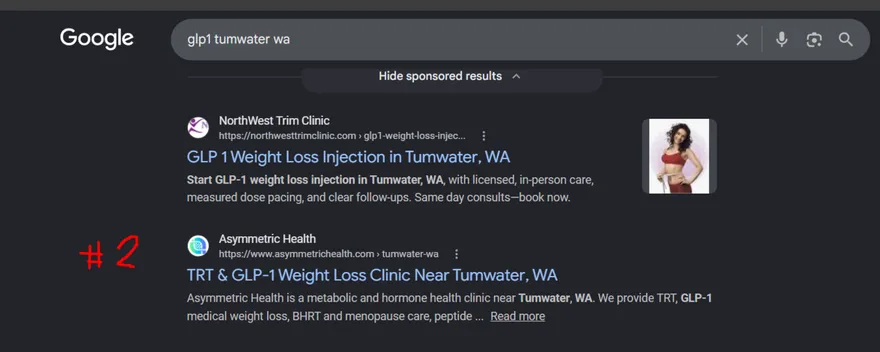
We did not try to out-bid them. That engagement was a website rebuild plus a healthcare SEO program, no ad spend at all, and two months after launch the clinic was #1 organic for its priority searches with Google's AI Overview recommending it by name.
That result is why this page keeps saying "pair paid with organic." When strong rankings carry the baseline patient volume, your Google Ads budget stays modest, stays targeted, and stops being a hostage to whatever the national players bid next quarter.
Where PPC fits
One program, three pieces that feed each other.
Time to #1
2 moWebsite rebuild plus a healthcare SEO program, from launch to #1 organic in 60 days
Organic rankings
#1The clinic's priority TRT, GLP-1, and peptide searches across its home market
AI Overview citation
1stGoogle's AI cites the clinic first, by name, with its pricing
Google map pack
Top 3Dominating the local pack at 5.0 stars, ahead of clinics based in Olympia
For the record: the Asymmetric Health engagement is website plus SEO. No paid advertising ran, so none of the numbers above are ad results. They are what the organic half of this program produces, which is exactly the point.
"Best business decision I've ever made! The calls started coming in left and right. I guarantee you will make your ROI in no time and the team is very responsive and helpful."
Tanner C.
Savo Group client · Google review
A defined process. No surprises.
Account audit, policy review & competitor scan
If an existing Google Ads account is in play, we audit it: wasted spend, disapproved ads sitting quietly in the account, geo-targeting bleed, broken match types. We also check every service line you want to advertise against Google's healthcare and medicines policy, because a campaign built around a restricted term gets disapproved before it spends a dollar. New account? We scope the competitive paid-search picture in your market first.
Local Service Ads, where your specialty is eligible
Google has been rolling Local Service Ads out to healthcare providers market by market. Where your specialty and metro qualify, we handle the verification (license checks, practice details, service configuration) and get you live. LSA is pay-per-lead rather than pay-per-click and sits above every other result on the page, which makes it the first paid layer worth turning on.
Search Ads build, split by service line and payment intent
Tight ad groups by service line (annual physicals, same-day sick visits, telehealth consults, screenings, women's health, weight management, whatever your practice actually offers), with insurance-intent queries and cash-pay queries in separate campaigns because they behave differently. Call extensions and online-booking sitelinks on everything. Geo-targeting locked to your real patient catchment.
HIPAA-conscious conversion & call tracking
We count conversions without handing patient data to an ad platform. Google will not sign a business associate agreement for Google Ads, so no patient identifiers, no condition details, and no appointment specifics ever go into a pixel. What we track: a call happened, a booking form was submitted, and which campaign produced it. That is all the ad account needs and all it should ever get.
Weekly tuning & negative-keyword discipline
Search-term reports reviewed every week. Wasted-spend queries negative-listed (job seekers, medical students, symptom research with no booking intent). Bids adjusted by hour, device, and geography. A set-and-forget medical PPC account drifts into waste within 60 to 90 days; a weekly-managed one gets more efficient every month.
Two clean lines. Not seven invoices.
Google Ads management is priced as its own line for one honest reason: the ad spend goes to Google, not to us, and you see every dollar of it in your own account.
Our management fee sits on top as a transparent, separate charge. We size budgets to the appointment volume your schedule can absorb, because a solo practice fielding thirty extra calls a month is a different engagement than a multi-location group that needs three hundred.
Everything else in the program (local SEO, organic SEO, AI search optimization, review generation, reporting tied to booked appointments) is one all-in-one monthly fee. Most agencies invoice those as five or six separate line items and let the total creep. We do not, and the discovery call gives you the actual numbers for your market and scope.
The complete marketing program for doctors.
Google Ads covers the ramp. SEO, AI search optimization, and a fast website build the patient pipeline that does not depend on next month's ad budget.
SEO for Doctors
Map Pack, organic rankings, and AI answers. The channel that took our anchor clinic to the top in two months, with no ad spend.
See SEO servicesAI Search Optimization
Get cited when Google's AI Overview, ChatGPT, and Perplexity answer patient questions. Our anchor clinic holds four citations by name.
See AI SEO servicesWebsite Design
Hand-coded medical practice websites where paid clicks actually convert: fast pages, clear booking paths, service pages matched to ad intent.
See how we build sitesQuestions doctors ask before spending a dollar on ads.
Google Ads for doctors is paid search advertising that puts your practice at the top of Google for the patient searches you choose, usually within days of launch. It runs in three layers:
- Local Service Ads: pay-per-lead, for the specialties Google has opened (dermatology, optometry, orthodontics, physical therapy, primary care, and a growing list)
- Search Ads: pay-per-click, with call and booking extensions
- Performance Max: cross-channel, added once real conversion data exists
Healthcare PPC also carries rules that other industries do not have: Google's healthcare advertising policies restrict certain categories, and conversion tracking has to be built so no patient data reaches the ad platform.
PPC is rented visibility: every click costs money, and the calls stop the day the budget pauses. SEO is owned visibility: rankings take months to build, then keep producing patient calls without a per-click charge.
For medical practices the two work best together. Paid fills the schedule in week one while the SEO program builds rankings that gradually take over the volume.
Our anchor healthcare client reached #1 organic in two months with SEO alone, no ad spend, which is exactly why we never tell a practice to rely on paid forever. See SEO for doctors.
Increasingly, yes. Google has been expanding Local Service Ads into healthcare categories in the US, rolling out by specialty and by metro. Where available, providers go through Google's verification (license checks and practice details) and appear above the regular ads with a verification badge.
LSA is pay-per-lead, so you pay when a patient actually contacts you rather than for every click. Eligibility depends on your specialty and market; checking it is part of our first-week setup, and where you qualify it is usually the highest-value paid placement on the page.
Google's healthcare and medicines policy restricts several categories:
- Prescription drug terms are limited to certified advertisers, so a clinic generally cannot bid on specific drug names
- Some treatment categories are restricted outright, including certain speculative or experimental treatments
- Addiction treatment services require LegitScript certification before Google will run the ads at all
- Some pharmacy and telehealth offerings carry their own certification requirements
- Google prohibits personalized ad targeting based on health conditions, which rules out most remarketing plays other industries use
None of this makes healthcare PPC impossible. It means the campaigns have to be built by someone who reads the policy before spending your money.
Google does not sign a business associate agreement for Google Ads, so the ad platform itself sits outside HIPAA. That does not stop a practice from advertising; it dictates how tracking gets built. The rule we run: no patient identifiers, no condition information, and no appointment details in any pixel or conversion upload.
We track that a phone call happened and that a booking form was submitted, tied back to the campaign that produced it, and nothing more. We also skip remarketing lists built from patient behavior, which Google's own health-condition personalization rules prohibit anyway. If an agency proposes retargeting your past patients, that is your cue to leave.
Two lines, and we keep them separate on purpose. The ad spend itself goes straight to Google, sized to the appointment volume your schedule can absorb, and you see every dollar of it in your own ad account. Our management fee sits on top of that as its own transparent line.
Everything else we do (local SEO, organic SEO, AI search optimization, review generation, reporting tied to booked appointments) is one all-in-one monthly fee rather than the six separate line items most agencies invoice.
Click prices themselves vary by specialty and metro: competitive, elective, and cash-pay service lines bid higher, and for reference, even the marketing terms doctors type when researching agencies run $11.50 to $37 per click on the open market.
Days. A Search Ads campaign that goes live on Monday is typically showing for your target searches the same day and producing its first patient calls within the first week. That speed is the entire reason paid exists in our program: it covers the gap while SEO builds.
Organic rankings for a medical practice usually take one to two months to start producing and keep compounding from there, so the practical sequence is paid calls in week one, organic calls layering in from month two, and ad spend tuned down as the free channels take over more of the volume.
For urgent, book-it-now intent, yes. Patients booking same-day sick visits, urgent consults, or "open now" searches on a phone do not want to browse a website; they want to tap once and talk to your front desk. Call-only campaigns skip the landing page entirely and dial your tracked line directly.
Higher-consideration searches (a patient comparing providers, researching a procedure, or checking whether you take their insurance) still get regular Search Ads pointed at a real service page. Every regular campaign runs call extensions regardless, so the phone number is one tap away either way.
You can, and plenty of practices do, and it is the most expensive way to buy patients. Without organic rankings underneath, every single call costs the full click price forever, and in specialties where VC-funded national telehealth companies are bidding, that price only moves up. The counter-move is not a bigger budget.
Asymmetric Health, a physician-led clinic, was losing local patients to exactly those national advertisers; a website rebuild plus SEO (no ad spend at all) put the clinic at #1 organic in two months with Cited by name in Google AI Overviews. Pair a modest, tightly targeted paid program with organic that compounds. Local SEO and SEO for doctors are where that starts.
Weekly, never set-and-forget. Search-term reports get reviewed every week, negative keywords get added, bids get adjusted by hour, device, and geography, and underperforming ad copy gets rewritten. Medical PPC accounts have an extra failure mode on top of the usual drift: policy disapprovals that silently stop ads from serving. We watch for those too. Reporting comes monthly and is tied to phone calls and booked appointments, not click charts.
Sources & data
- Semrush US database: keyword volume and CPC data for the healthcare marketing term cluster cited on this page, fetched July 10, 2026. Nine queries, $11.50 to $37.00 CPC, average $19.72.
- Google Ads healthcare and medicines policy: official documentation on restricted drug terms, restricted treatment categories, and certification requirements including LegitScript. support.google.com/adspolicy
- Google Ads personalized advertising policy: documentation on the prohibition of ad personalization based on health conditions. support.google.com/adspolicy
- Google Local Services Ads: official documentation on eligibility, verification, and the pay-per-lead pricing model. ads.google.com/local-services-ads
- Google Performance Max: Google Ads documentation on the cross-channel campaign type. support.google.com/google-ads
- Asymmetric Health case study: the website + SEO engagement referenced on this page, including the two-month climb to #1 organic and the AI Overview citations. No paid advertising ran in that engagement. savogroup.com/project/asymmetric-health
Google Ads for Doctors · Nationwide
We work with doctors nationwide. The cities below are markets where we run a dedicated local google ads program with hand-written content, real Semrush keyword data, and city-specific FAQs. Your city not listed? We'll scope a google ads program against your specific market when you reach out.
Don't see your city? We work with doctors in every state. Get a free doctor google ads report on your business and your local market.
Get a free Google Ads reportWant to know what a patient click costs in your market?
Start with a free SEO Report on your practice: where you rank today, what your local paid auction looks like, and whether Google Ads, SEO, or both is the right first move for your specialty and metro. We also publish market pages for the cities where we currently work.