Healthcare SEO, AI SEO, and Web Design Services in Austin, TX
Healthcare marketing for the Austin submarkets that decide a practice's growth: research-everything downtown professionals, the Domain tech corridor, cash-pay Westlake, South Austin families, and the Round Rock and Georgetown suburbs where the growth actually landed.


See what you're missing in Austin, TX.
Send us your site. We'll pull your Map Pack positions, organic rankings, GBP health, and site speed for Austin doctor queries, then send the numbers back inside 24 hours. No call required.
Fifteen minutes with a senior strategist.
Tell us what's going on with your Austin, TX doctor market. We'll tell you what we'd actually do, what it would cost, and whether we think the project is a fit. No pitch deck.

See what you're missing in Austin, TX.
Send us your site. We'll pull your Map Pack positions, organic rankings, GBP health, and site speed for Austin doctor queries, then send the numbers back inside 24 hours. No call required. No sales pitch.
2 mo
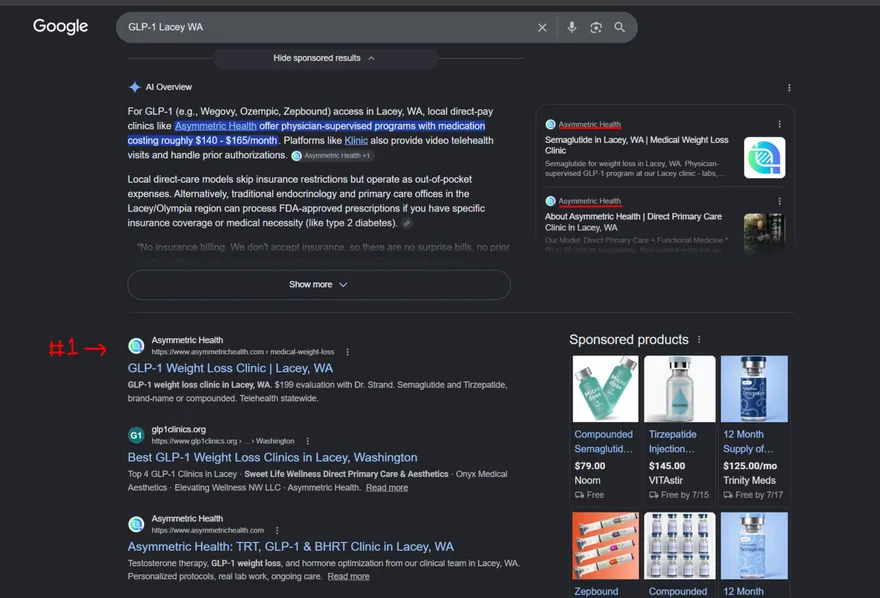
From launch to the top of organic for our DPC client Asymmetric Health
5.0★
Google rating that put Asymmetric Health at the top of the local pack
979,882
Austin pop. · Travis County
27
Years of SEO · since 1999
Austin patients read reviews, hunt for pricing, and ask ChatGPT before calling. What does that mean for a practice's SEO program?
- Austin population
- 979,882
- Travis County
- Top services
- Direct primary care and concierge medicine
- Dermatology and med-spa
- Search volume
- 6,890/mo
- 100 city-modified queries
- Map Pack timeline
- 60-90 days
- For properly-built GBPs
Austin is the most research-driven patient market in Texas. Patients skew young, tech-employed, allergic to friction: comparing reviews, expecting online scheduling, asking AI which doctor to see. Ascension Seton and St. David's hold most of the beds, and Dell Medical School is young, so institutional search gravity runs lighter than Houston's or Dallas's. Independents who do the work have room.
What Makes Austin, TX Different
Top services
-
Direct primary care and concierge medicine
Self-employed and startup-employed Austin is the natural DPC demographic, and Texas is the model's friendliest state. Winning content explains the membership math and publishes the price.
-
Dermatology and med-spa
Crowded along South Congress and the Domain. Differentiation content (subspecialty focus, physician-performed procedures, transparent package pricing) is the ranking lever, not more generic service pages.
-
Mental health and psychiatry
Waitlists across the metro run long. A practice with real availability that states it plainly ('appointments this week') converts searchers other practices leave on hold.
-
Sports medicine and physical therapy
Lady Bird Lake runners, Barton Springs swimmers, cyclists, and climbers keep recreational-injury volume enormous year-round. Activity-specific content outranks generic ortho copy.
-
Medical weight loss (GLP-1)
National telehealth takes this revenue by default. Local pages that compare the in-person model honestly, with physician oversight and lab work named, pull it back.
Austin marketing snapshot
- Region
- Central Texas
- County
- Travis County
- Population
- 979,882
- PPC competitive level
- high
- Surrounding cities served
- 6
System landscape: Ascension Seton runs Dell Seton Medical Center at UT (Level I adult trauma) plus a metro network; St. David's HealthCare runs the other half; Baylor Scott & White pushes in from the north. Dell Medical School (first class 2016) is thickening the specialist bench.
Austin Regional Clinic, the homegrown multispecialty group, is the default for a huge share of insured primary care, so an independent primary care practice always ranks against a familiar incumbent.
Submarkets, briefly. Westlake and Tarrytown hold the concierge and cash-pay wealth. Downtown, East Austin, and Mueller skew young-professional: online booking, weekend hours, and review depth decide them. The Domain and the North Austin tech corridor (Apple's campus) generate daytime demand near the office. South Austin is families plus the service workforce.
The real growth story is the suburban ring: Round Rock, Cedar Park, Pflugerville, Georgetown (repeatedly the fastest-growing city in the country), Kyle. Each has more new rooftops than clinic capacity, and practices that build genuine pages for them harvest demand the systems' satellite strategy hasn't reached.
Practice economics: ad costs run with Dallas's, the South Congress and Domain aesthetics scene is crowded, and mental health waitlists run long; a psychiatry practice with real availability ranks on it alone, if stated. Cash-pay share is Texas's highest, but patients expect the price on the site before booking. Publish self-pay pricing and AI Overview citations follow; hide it and patients go to whoever didn't.
Questions Austin Doctors Ask Before Signing On
Yes, because the national funnels have a weakness they can't fix: they aren't local and they aren't a relationship. The patient searching "glp-1 austin" sees national brands first only when no local practice has published anything worth ranking.
The counter is a page that does what telehealth does (clear pricing, clear process, what's included) plus what it can't: a named Austin physician, in-person labs and follow-up, reviews from your ZIP code. AI Overviews reward that specificity and prefer local answers when one exists. Most Austin practices haven't written one. That's the opportunity.
Yes, in one important way. An insurance-based practice competes on proximity and availability; a DPC practice has to sell a model before it sells an appointment.
The demand splits into people who know the term (small volume, extremely high intent: "direct primary care austin") and the larger pool searching their frustration ("doctor without insurance austin", "flat fee doctor"). The site needs both: a plain-English explanation of the membership with the actual monthly price, and pages that catch the frustration queries.
Austin is arguably the best Texas city for this, but only if the price is on the page. A DPC site that hides pricing is self-defeating.
More than almost anywhere else in Texas. The patient base is unusually review-driven, and central Austin primary care and dermatology packs are typically held by practices with review counts in the high hundreds.
Raw count is only half the math. Velocity and content (recent reviews that mention your services and neighborhoods) matter as much, and a practice adding 15 to 25 genuine reviews a month through a post-visit flow closes seemingly impossible gaps inside a year.
The suburbs are a different story: Cedar Park, Kyle, and Pflugerville packs turn over with far lower counts, one more reason the growth ring is the most efficient place to build.
Let us take a look at Austin, TX.
Tell us your service area, your services, and the mix of SEO, AI Search, Web Design, and PPC you're considering. We'll scope it against the actual Austin market.