Healthcare SEO in Texas: 12 markets, one program.
From the Texas Medical Center's shadow in Houston to the DFW suburbs, the Austin growth ring, and the border markets that search in Spanish first. Healthcare SEO for Texas doctors covers local SEO, organic SEO, AI search optimization, a hand-coded website, and Google Ads, with the inputs (institutional density, ad costs, TRICARE pools, language mix) tuned to the market your practice actually competes in.

Family-owned agency · Healthcare marketing nationwide · SEO since 1999
Find out where your practice stands.
Send your practice name and city. We'll pull your map pack positions, Google Business Profile health, review velocity, and the AI answers patients in your Texas market are already seeing, then send the numbers back inside 24 hours.
Fifteen minutes with a senior strategist.
Tell us about your practice and the Texas market you serve. We'll tell you what we'd actually do, how long it should take, and whether the engagement is a fit. No pitch deck.
What does healthcare SEO in Texas actually look like, and why is one statewide strategy a mistake?
Texas is at least four healthcare markets pretending to be one state. Houston has the Texas Medical Center, the largest medical complex in the world, which means the branded search results are locked up by institutions and independents win neighborhood by neighborhood.
DFW is the most system-saturated search market in the state, with UT Southwestern's academic gravity and Baylor Scott & White, Texas Health, and Medical City each running find-a-doctor directories that soak up organic clicks.
Austin patients research everything and default to national telehealth unless a local practice interrupts them. And the border markets, El Paso and Laredo, are among the most medically underserved metros in the country, where the search happens in Spanish first and the marketing problem is visibility, not competition.
The program itself is the same everywhere: local SEO (Google Business Profile, healthcare-directory citations, review velocity), organic healthcare SEO (condition and cost pages, physician schema), AI search optimization for Google's AI Overview and ChatGPT, medical website design built by hand, and Google Ads. What changes per market is the Texas-specific inputs.
No state income tax keeps pulling physicians in, so your map pack competition is newer and thinner than it looks. The suburbs (Katy, Frisco, Cedar Park, the Alliance corridor) built rooftops years ahead of clinics.
Direct primary care has more traction here than nearly anywhere in the country. And bilingual patient search is not a checkbox; in whole corridors of Houston, San Antonio, El Paso, and Laredo it's the primary language of the market.
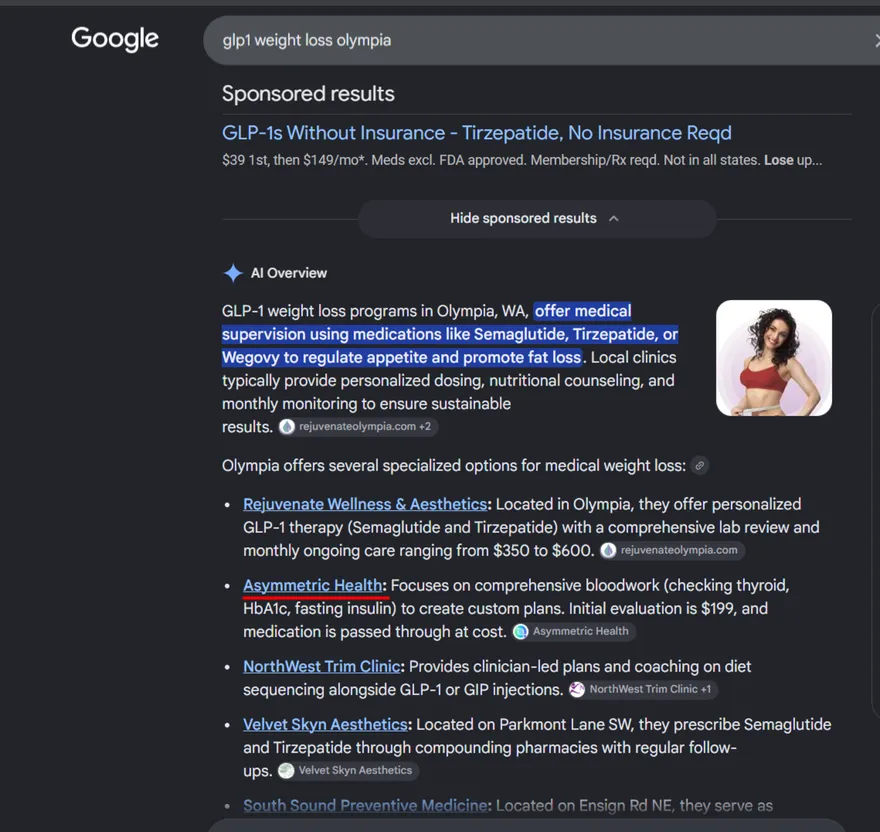
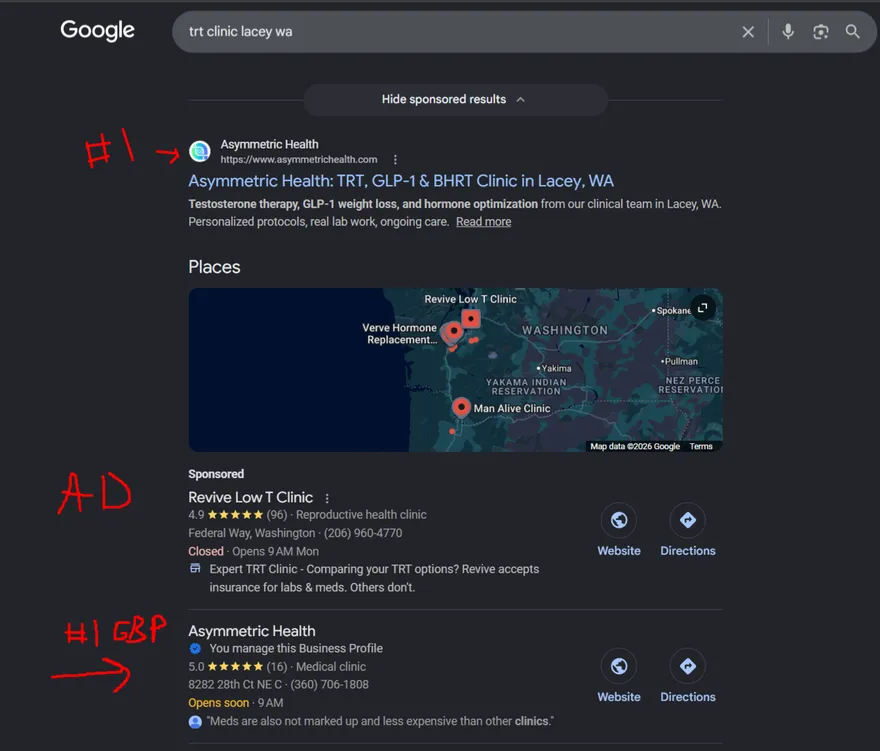
The proof behind the program is placement. Asymmetric Health, a physician-led Direct Primary Care clinic in Lacey, WA specializing in TRT, GLP-1-assisted medical weight loss, and BHRT, went from a slow WordPress site to #1 organic for its priority searches in two months, cited first by Google's AI Overview and holding a top-3 map pack position at 5.0 stars.
Same build, applied to your Texas market: realistic targets are map pack placement on neighborhood queries inside 90 to 120 days, first AI citations inside 1 to 2 months, and faster compounding in the border, West Texas, and suburban growth markets than in the metro cores.
Healthcare SEO across Texas: four regions, four different markets.
Texas healthcare SEO strategy is set region by region: institutional density, ad costs, TRICARE patient pools, Spanish-language search share, and suburban growth patterns all shift as you move from the Metroplex to the border. Click into your city for the local market breakdown.
System-saturated search results, wide-open map packs, and suburbs growing faster than their clinics.
UT Southwestern, Baylor Scott & White, Texas Health, and Medical City hold DFW's branded results, but the map pack ranks locations, not brands. Arlington has no academic center soaking up its results, and the Alliance and Plano growth corridors built rooftops years ahead of clinics.
The world's largest medical complex, and a coastline of patients far past the city limits.
Houston patients search past more branded healthcare than anyone in the country, so independents win it neighborhood by neighborhood, in English and in Spanish. Corpus Christi is the opposite: a regional hub whose Coastal Bend patients drive in because there is nowhere closer.
Military City USA and the most research-driven patients in Texas.
San Antonio spreads TRICARE families and Spanish-first neighborhoods around a 900-acre medical center; practices that document TRICARE acceptance plainly capture patients competitors never mention. Austin patients compare reviews, expect online booking, and ask AI assistants which doctor to see.
Shortage markets where visibility, not competition, is the problem.
El Paso and Laredo search fluidly in two languages and have been short on physicians for decades; Laredo patients drive 150 miles for care a local practice could keep. Lubbock serves a catchment measured in counties. In all three, whoever shows up properly, wins.
What Texas Patients Search, City by City
Monthly Google searches for doctor queries that name the city, from the Semrush US database, July 2026. These counts are the floor: patients searching by specialty or with “near me” add to every bar. Click a city for its full market breakdown.
Top query: "fertility doctors in houston tx"
Top query: "laredo tx doctors hospital"
Top query: "eye doctor austin tx"
Top query: "eye doctor san antonio tx"
Top query: "eye doctor dallas tx"
Top query: "eye doctors in lubbock tx"
Top query: "eye doctor arlington tx"
Top query: "eye doctor el paso tx"
Top query: "eye doctor fort worth tx"
Top query: "doctors of internal medicine in plano tx"
Top query: "doctors regional in corpus christi tx"
Top query: "eye doctor irving tx"
Source: Semrush US database, fetched July 2026. Each bar counts monthly Google searches for doctor queries that include the city name. Specialty and "near me" searches add to every total.
Local SEO, healthcare SEO, AI search, website design, and Google Ads for Texas doctors.
Five services, one bundled monthly program, quoted against your specific market. Healthcare digital marketing for Texas practices only works when all five point at the same patient base.
Service
Local SEO for Texas Doctors
Local SEO for Texas doctors wins the map pack for "pediatrician katy tx" or "dermatologist plano": Google Business Profile rebuild, healthcare-directory citation cleanup, and a post-visit review flow that competes with incumbents holding counts in the hundreds. It moves fastest in the growth suburbs, where half the competition launched recently with a templated site and an unclaimed profile. Target: map pack placement inside 90 to 120 days.
Learn more →
Service
Healthcare SEO for Texas Practices
Healthcare SEO in Texas means ranking for what patients run before booking: condition pages, cost and self-pay pricing content, physician credential pages with proper schema, and hand-written Spanish pages where the market searches in Spanish. Concede the branded institutional queries to UT Southwestern and the Texas Medical Center. Take the neighborhood and service-level demand the systems are too big to localize.
Learn more →
Service
AI SEO for Texas Doctors
Google's AI Overview answers Texas healthcare cost and condition queries by quoting practices that publish specifics. AI SEO for Texas doctors builds the foundation those citations pull from: clean indexable HTML, MedicalBusiness and FAQPage schema, declarative content, and transparent self-pay pricing. A system's generic service-line page gives the AI nothing quotable; your page becomes the specific answer.
Learn more →
Service
Medical Website Design for Texas Practices
Hand-coded in Astro: fast on a phone, online booking and click-to-call up front, real physician photography, and condition pages built for AI extraction. Where the market needs it, medical website design in Texas includes hand-written Spanish pages at /es/ paths with proper hreflang, because in El Paso, Laredo, and half of Houston the patient search starts in Spanish. No WordPress, no page builders.
Learn more →
Service
Google Ads / PPC for Texas Doctors
PPC for Texas doctors fills the schedule while the SEO compounds: Search ads on condition and neighborhood queries, tuned per market because the economics swing hard across the state. Costs run high in Dallas, Houston, and Austin and drop sharply in El Paso, Lubbock, and Laredo, so Google Ads is budgeted market by market, never statewide. Tracked to booked appointments, not click charts.
Learn more →
Two specialty programs come up constantly in Texas: urgent care marketing for the suburban growth rings where same-day demand follows the rooftops, and physical therapy marketing for the youth-sports and post-surgical rehab demand that runs year-round across DFW and Central Texas.
Questions Texas doctors ask before signing on.
All across Texas. The same program (local SEO + organic healthcare SEO + AI search optimization + hand-coded website + Google Ads) runs for practices in Houston, San Antonio, Dallas, Austin, Fort Worth, El Paso, Arlington, Corpus Christi, Plano, Lubbock, Irving, and Laredo, plus the suburbs and drive-in towns around each of them.
The regional inputs change per market: institutional density, ad costs, TRICARE patient pools, Spanish-language search share, suburban growth patterns. The underlying program stays the same.
By fighting where their size doesn't help. The systems own the branded searches and the informational queries, and you should concede those without a second thought. What they don't own is the transactional local layer: the map pack is ranked on proximity, profile quality, and reviews, three things a single practice controls completely. And Google's AI Overview favors pages that answer a specific question with a specific fact.
A practice that publishes its actual self-pay prices, its actual physicians, and its actual same-week availability gives the AI something quotable that a hospital system's generic service-line page never will. An academic medical center cannot publish a price or promise an appointment this week. You can, and that asymmetry matters more than their domain authority on every query that ends in a booking.
In the border markets, it's the whole game. El Paso is over 80 percent Hispanic and Laredo around 95 percent; in both cities the search for a doctor happens in Spanish as readily as English, and Juárez families research US care online, in Spanish, before crossing.
In the big metros it decides specific corridors: Houston's East End and Gulfton, San Antonio's south and west sides, Dallas's Oak Cliff, Fort Worth's Northside.
Doing it right means hand-written Spanish service pages at /es/ paths with hreflang tags, Spanish content on the Google Business Profile, and a front desk that can take the call in Spanish.
Machine-translated mirrors don't work; patients notice and so does Google. For most of these searches there are only one or two real Spanish-language results, which is exactly why it converts so well for the practices that do it properly.
Usually the growth ring, and Texas has the best growth rings in the country.
Katy and Cypress outside Houston, Frisco and McKinney north of Plano, the Alliance corridor in far-north Fort Worth, Cedar Park and Georgetown around Austin: all of them built rooftops years ahead of clinics, and new-subdivision households all repeat the same ritual, searching for a pediatrician, a family doctor, and an urgent care within weeks of moving in.
They take whoever ranks. Map packs there turn over with review counts that would be entry-level in central Dallas or Austin, and the practice that becomes the default answer while the pack is half-empty inherits whole subdivisions of patients and keeps them for years. Downtown prestige addresses are for referral-driven subspecialists. Panels get built where the moving trucks are unloading.
Yes, when the technical and content foundation supports it. AI Overview, ChatGPT Search, and Perplexity all pull from pages with clean indexable HTML, healthcare-specific schema, declarative content, and real authority signals: reviews, consistent listings, named physicians. The proof is placement, not promises.
Asymmetric Health, a physician-led Direct Primary Care clinic in Lacey, WA specializing in TRT, GLP-1-assisted medical weight loss, and BHRT, is cited first by Google's AI Overview for its priority searches, ranked at the top of the organic results within two months of launch, and holds a top-3 map pack position at 5.0 stars.
That's the same build we run for Texas practices, and it matters most in exactly the Texas niches national telehealth is targeting: GLP-1 weight loss, TRT, dermatology. See AI search optimization for doctors.
Map pack visibility from a properly rebuilt Google Business Profile lands in 2 to 6 weeks. First organic rankings and AI Overview citations typically show inside 1 to 2 months, and neighborhood-level map pack placement inside 90 to 120 days.
The head terms in Dallas, Plano, Houston, and Austin take longer, because the incumbents hold review counts in the hundreds and closing that gap is a months-long, systematic effort, not a trick.
The flip side: El Paso, Laredo, Lubbock, Corpus Christi, and every growth suburb compound faster than the metro cores, because the competitive density is a fraction of what the population justifies. Anyone promising top rankings statewide in 30 days is lying. The honest version is a market-by-market timeline quoted after we look at your actual competition.
Ready to rank across your Texas market?
The free Texas SEO Report covers your current Google Business Profile, citation footprint, review velocity, map pack positions, and the AI answers patients in your market already see. We show you the gaps before quoting anything.
Family-owned agency · Healthcare marketing nationwide · SEO since 1999