Audiology Marketing for Independent Hearing Practices
Audiology marketing is the work of getting a hearing practice found by the two people who decide where a hearing aid gets bought: the patient searching "audiologist near me", and the son or daughter researching hearing aids for a parent from another city. A hearing aid purchase runs thousands of dollars and the research takes years, so the practice that shows up throughout that research wins it.
This page covers how we do that: local SEO, patient education content, AI search visibility, and ads when you need the schedule full now.


See where your practice stands.
Send us your site. We'll pull your map pack positions, organic rankings, Google Business Profile health, and the AI answers patients in your market already see, then send the numbers back inside 24 hours. No call required.
Does an independent audiology practice actually need a marketing agency?
It needs the work, and almost nobody in your market is doing it. Semrush scores "audiology marketing" a 3 out of 100 for keyword difficulty. Translated: the specialized-agency space for hearing practices is close to empty, and that emptiness runs downstream.
If the agencies are not competing here, the odds are good that no practice near you has a serious SEO program either. The Map Pack, the organic results, and the AI answers for "audiologist near me" in your city are winnable at a cost that would be laughable in dermatology or plastic surgery.
The specialty rewards it more than most, too. Hearing patients research for years, not days, and much of that research is done by adult children on a parent's behalf. A practice with real patient education content gets found at every step of that cycle. A practice with a five-page brochure site gets found once, if at all.
A search category with almost nobody in it.
These are the US searches practice owners run when they go looking for audiology marketing help. Look at the difficulty column. Semrush scores keyword difficulty from 0 to 100, and a 3 means the field is barely contested.
Compare that with "healthcare marketing" at a difficulty of 50 on our main healthcare SEO page and you see what a quiet corner audiology is. Quiet cuts both ways: fewer agencies chasing you, and fewer competitors near you doing this work at all.
| Search query | Monthly volume | Difficulty (0 to 100) |
|---|---|---|
| audiology marketing | 390 | 3 |
| hearing aid marketing | 140 | 8 |
| audiologist marketing | 70 | 3 |
Data source: Semrush US database, fetched July 13, 2026. Google charges $8.49 per click on "audiology marketing" and "audiologist marketing", which tells you agencies still pay real money to reach practice owners even in a thin field. Patient-side demand ("audiologist near me", "hearing test" plus your city, hearing aid comparisons) is scoped for your specific market during discovery.
Hearing patients shop slowly, and half the research is not done by the patient.
Most healthcare marketing assumes a patient who searches, compares, and books within a week. Audiology does not work that way, and marketing a hearing practice like an urgent care wastes the money. Four things make this specialty its own problem.
The purchase is measured in years and thousands of dollars.
A pair of prescription hearing aids runs into the thousands, and the typical patient takes years between first noticing hearing loss and actually buying. During that stretch they search in loops: is my hearing actually getting worse, what does a hearing test involve, how do the styles compare, what does insurance cover, is financing a thing.
The practice that publishes honest answers to those questions is present for the entire cycle. The practice with a homepage, a staff photo, and a phone number appears exactly once, at the very end, competing on nothing but proximity.
Your website has two readers, and one of them lives somewhere else.
The patient is often 60 or older. The researcher is often their adult son or daughter, comparing audiologists for Mom from three states away. That second reader never drives past your sign and never sees your waiting room.
They judge you entirely on what Google shows them: your reviews, your pages about testing and pricing, and whether an AI answer mentions you when they ask who is good near their parent. Build the site for the remote researcher and you win the patient who never searched at all.
OTC hearing aids redrew the map in 2022.
The FDA's over-the-counter hearing aid rule put hearing aids on pharmacy and big-box shelves, and every independent audiologist felt it. The response is not to compete on price with a drugstore. It is to sell what the shelf cannot: diagnostic testing, professional fitting, programming matched to a real audiogram, and follow-up care when the device is not right.
Patients are actively searching for that comparison, "OTC hearing aids vs audiologist" in a hundred phrasings, and the practices whose websites answer it in plain language are the ones that convert the doubters.
Reviews from older patients are an AI asset most practices never claim.
Read the Google reviews of a good audiology practice and a pattern jumps out: patients write about patience. About not being rushed, about staff who explained things twice without sighing, about follow-up visits that fixed a whistling hearing aid for free. When someone asks Google or ChatGPT who to see about hearing loss in your town, those phrases are the raw material of the answer.
A steady, policy-compliant review request after every visit compounds into something no competitor can shortcut. The searches carrying the intent are local and specific: "audiologist near me" and "hearing test" plus a city name, which is why the local SEO layer and the review base have to be built together.
What the program covers for a hearing practice.
One monthly fee, one program. The pieces below reinforce each other, which is exactly why invoicing them separately (the industry habit) produces six line items and no results.
Google Business Profile, built for hearing searches
Audiologist categories, the full service list (testing, fittings, repairs, earwax removal, tinnitus care), hours, photos, and posts. Most audiology profiles we look at are half-finished, which in a low-competition specialty means finishing yours properly is a ranking move by itself.
Patient education content
Hearing test explanations, hearing aid style and technology comparisons, OTC-versus-prescription pages, and insurance and financing answers. This is the library the patient and their family read across a multi-year research cycle, and it is the single biggest gap on independent audiology websites.
City and service-area pages
Pages for each town you actually draw patients from, targeting "audiologist near me" and "hearing test" plus the city. Hearing patients rarely cross a metro area for care, so ranking in the three or four towns around you is worth more than ranking weakly across fifty.
AI search visibility
Schema markup and declarative page structure so AI answers can cite your practice by name when a family member asks who to see about a parent's hearing. The same structured content feeds Google's AI Overview, ChatGPT, and Perplexity. Details on the dedicated AI SEO page.
Review generation that follows Google's rules
Every patient gets asked after their visit. Nobody gets filtered by sentiment, nobody gets a gift card, because Google prohibits both. Responses are handled for you, written so no public reply ever confirms a treatment relationship.
HIPAA-conscious reporting
Monthly reporting on rankings, Map Pack positions, calls, and booked hearing tests. No patient identifiers in tracking pixels, no form contents passed to ad platforms, and call tracking configured with compliance in front of mind.
The evidence we can show you, and what it is not.
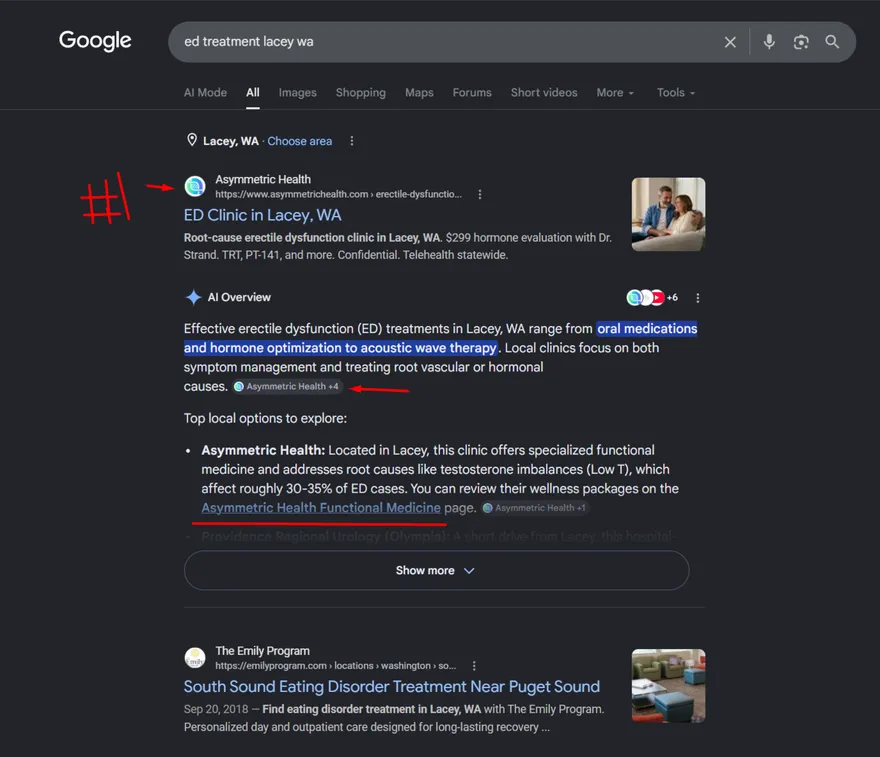
We do not have an audiology client yet, so you will not find one dressed up below, and any agency showing you suspiciously perfect audiology numbers deserves a hard look. What we can show is the same program run for Asymmetric Health, a physician-led direct primary care clinic (trt, glp-1, bhrt) serving 500+ patients.
They came to us losing local patients to VC-funded national telehealth companies, the same shape of fight an independent audiologist has with national hearing aid chains and big-box retail. The engagement has been active since 2026, and the numbers are current, not a retrospective.
Time to #1
2 moWebsite rebuild plus a healthcare SEO program, from launch to #1 organic in 60 days
Organic rankings
#1The clinic's priority TRT, GLP-1, and peptide searches across its home market
AI Overview citation
1stGoogle's AI cites the clinic first, by name, with its pricing
Google map pack
Top 3Dominating the local pack at 5.0 stars, ahead of clinics based in Olympia
A local clinic out-ranking national money in two months is the transferable part. The audiology version of that fight runs through the same three assets: a finished profile, a real review base, and content the big competitors will never write for your town. You can also see the markets where we run this program.
Read the case studyFive services, one engagement.
Each of these has its own page with the full detail. For an audiology practice they arrive as one program, not a menu.
Healthcare SEO
The full organic program: technical foundation, content, schema, and rankings that compound instead of expiring like ad spend.
See the full pageLocal SEO
The Map Pack work. For "audiologist near me" and "hearing test [city]" searches, this is where the calls come from first.
See the full pageAI Search Optimization
Getting your practice named when families ask Google's AI, ChatGPT, or Perplexity who to see about a parent's hearing.
See the full pageWebsite Design
Hand-coded builds that load fast for a 70-year-old on a tablet and read clearly for their kid on a phone at work.
See the full pageGoogle Ads / PPC
Fills the hearing test schedule while the SEO builds, with no patient data leaking into ad platforms.
See the full pageFour phases, starting with your market, not a template.
Market mapping
We pull your rankings, your Google Business Profile data, and the searches hearing patients in your area run: "audiologist near me", brand comparisons, and the insurance questions families ask. We also check who holds those results now. Usually a national hearing aid chain, a directory, or nobody in particular, and each is a different fight.
Foundation
Technical cleanup, site speed, and schema markup (MedicalClinic, Audiologist categories, FAQPage). Google Business Profile built out completely: services, hours, photos, and the hearing-specific categories most practices leave blank. Citations matched across the directories patients and their families check.
Patient education build-out
Pages for the whole research cycle: what a hearing test involves, how hearing aid styles compare, what fitting and programming mean, what insurance covers, and how financing works. This is the content a spouse or adult child reads for months before anyone calls, and almost no independent practice publishes it.
Reviews, tracking, iteration
A post-visit review request that goes to every patient, never filtered by sentiment and never incentivized, because Google prohibits both. Then monthly content, rank tracking, and reporting tied to calls and booked hearing tests, with analytics kept HIPAA-conscious throughout: no patient data in tracking pixels, nothing sensitive passed to ad platforms.
What audiologists ask us before signing on.
Audiology marketing is the work of getting a hearing practice found by the people deciding where a hearing aid gets bought: the patient searching "audiologist near me" or "hearing test" plus a city, and the family member researching hearing aids, prices, and reviews on their behalf.
In practice that means ranking your website and Google Business Profile in the local Map Pack, the organic results, and the AI answers that now sit above both, plus the patient education content that carries a slow buyer through a long research cycle.
The buying cycle. An urgent care patient searches, clicks, and shows up the same day. A hearing patient often takes years between first noticing hearing loss and buying a hearing aid, and the purchase runs thousands of dollars per pair.
That changes the marketing math completely: the practice that publishes real education content (what a hearing test involves, how hearing aid styles compare, what insurance covers) is the one the patient and their family keep coming back to during those years of research. A five-page brochure site has nothing for that reader.
The second difference is the audience. Much of the research is done by adult children on behalf of a parent, often from another city, so the website has to convince someone who will never walk past your office.
Since the FDA's over-the-counter hearing aid rule took effect in 2022, hearing aids have been on pharmacy and big-box shelves. Trying to out-price that is a losing game. What retail cannot sell is the clinical side: diagnostic testing, professional fitting, programming matched to an actual audiogram, and follow-up care when something is not right.
Your marketing should say that plainly and in detail, because patients comparing a $300 OTC device to a professionally fitted pair are searching for exactly that comparison. The practices whose websites answer it are the ones that get the consultation.
Not yet, and we are not going to pretend otherwise. Our anchor healthcare client is Asymmetric Health, a physician-led Direct Primary Care clinic specializing in TRT, GLP-1-assisted medical weight loss, and BHRT that came to us losing local patients to VC-funded national telehealth companies.
Two months after we rebuilt their site and started the SEO program, they were top-ranked organically for their priority searches, cited first, by name, in Google AI Overviews, and at the top of a neighboring city's local pack at 5.0 stars. Different specialty, same fight: a local clinic against bigger-budget national competitors, won with local presence and better content. The full case study is public.
One monthly fee for the whole program: local SEO, organic SEO, AI search optimization, review generation, and reporting, quoted against your market and how many towns you pull patients from. We do not split it into six invoices the way most agencies do.
Website design is its own project, starting at $3,000+, with two payment options: pay upfront and the engagement runs 6 months, or spread the build across 12 months as part of the package. Google Ads is the only other separate line, because that spend goes to Google, not to us.
Map Pack movement usually starts within weeks of Google Business Profile work, because most audiology profiles are so thin that finishing one properly is itself a ranking change. Organic results typically follow in 1 to 3 months.
Our benchmark is Asymmetric Health at #1 organic in 2 months, though that engagement included a full site rebuild, which is part of why it moved fast. If you need hearing test appointments this month, Google Ads runs alongside while the SEO builds.
The same way it works everywhere, just slower and more valuable. Every patient gets a review request after their visit, no filtering by sentiment and no incentives, because Google prohibits both and a policy strike costs a healthcare practice more than most.
What is specific to audiology is what those reviews say: older patients write about being listened to, about staff patience, about follow-up visits that were not rushed. Those exact phrases are what AI tools quote when someone asks who to see about hearing loss, and no ad budget can buy them. We also handle responses, written so no public reply ever confirms someone was your patient.
Yes, and for an audiology practice this is not optional paperwork. Hearing loss is health information. So: no patient identifiers in tracking pixels, no form contents passed to ad platforms, no third-party scripts on appointment or intake pages, and call tracking configured deliberately rather than left on defaults. If your compliance reviewer wants something removed, it gets removed. Measurement that creates a breach is worse than no measurement.
Other specialties we write for
Sources & data
- Semrush US database: keyword volume, keyword difficulty, and CPC for the audiology marketing queries cited on this page. Fetched July 13, 2026.
- FDA over-the-counter hearing aid rule: the 2022 regulation that made OTC hearing aids available in retail, referenced in the competitive sections above. fda.gov/medical-devices/consumer-products/hearing-aids
- Google Maps user-contributed content policy: the prohibition on review gating and incentivized reviews behind our review generation rules. support.google.com/contributionpolicy/answer/7400114
- Asymmetric Health case study: the engagement record behind every client claim on this page: 2 months to #1 organic, #1 organic rankings across its priority searches, first-position AI Overview citations, #1 Olympia local pack at 5.0 stars. savogroup.com/project/asymmetric-health
Find out what "audiologist near me" shows in your town.
The free Audiology SEO Report covers your Map Pack positions, organic rankings, AI answer visibility, review profile, and site speed, with what we would fix first. Send us your site, get the numbers back. No call required, and in a specialty this uncontested, the report usually makes the case by itself.