Physical Therapy Marketing: Grow Past the Referral Pipeline.
Physical therapy marketing is the work of getting a PT clinic found by patients directly: the condition searches people run after an injury, "physical therapy near me", and the direct access patients who never learned they can book a PT without a referral. Decades of referral dependence left most clinics invisible on Google.
That is bad news for the industry and good news for whichever clinic in your market fixes it first.


See where your practice stands.
Send us your site. We'll pull your map pack positions, organic rankings, Google Business Profile health, and the AI answers patients in your market already see, then send the numbers back inside 24 hours. No call required.
Is physical therapy marketing worth it when referrals already fill most of the schedule?
Yes, because the referral pipeline is capped and it does not belong to you. Hospital systems increasingly route rehab to their own departments, and physician-owned PT keeps referrals in-house. Meanwhile the patients themselves have moved: after an injury they search the problem and their city, read reviews, and book. A clinic with no search presence is invisible at that moment, no matter how good its outcomes are.
The overlooked part is direct access. Every state, plus DC, allows some form of seeing a physical therapist without a physician referral, yet most patients have no idea. Clinics that market direct access, on their site and in their local rankings, tap demand their competitors never see.
And because the whole industry leaned on referrals for decades, the local search space for physical therapy is unusually winnable: keyword difficulty on "physical therapy marketing" itself is just 11 out of 100.
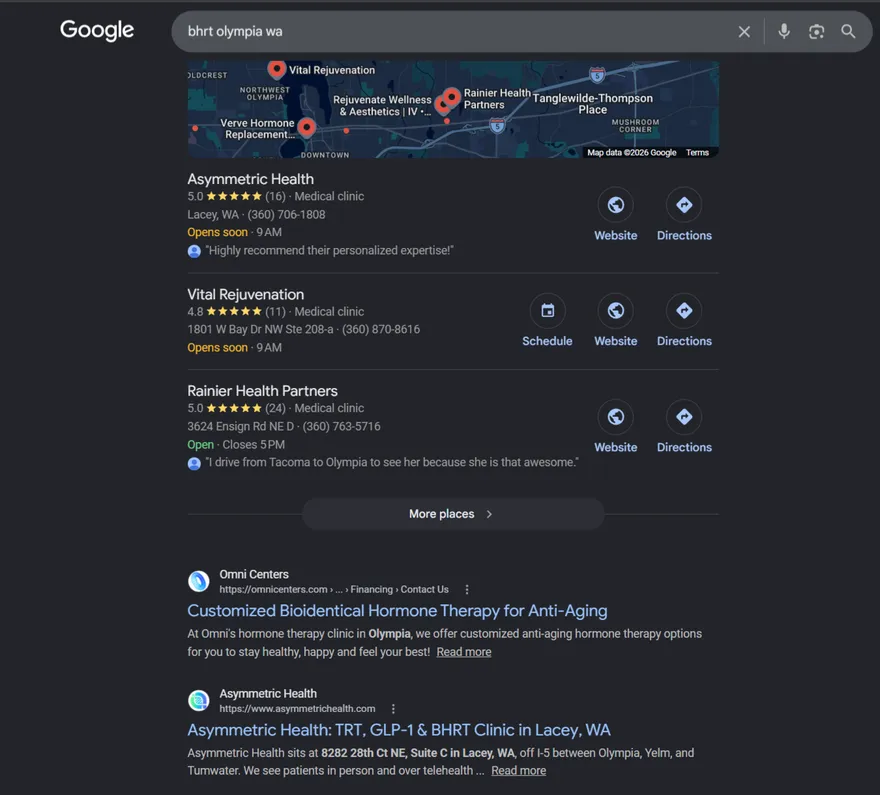
We will be straight about our proof: it comes from an adjacent specialty. Asymmetric Health, a physician-led cash-pay clinic, went from site launch to #1 organic in 2 months against VC-funded national competitors, and now holds Cited by name in Google AI Overviews. Independent local clinic versus corporate marketing budgets is exactly the matchup an independent PT practice faces.
What "physical therapy marketing" searches look like in the data.
These are the queries PT owners and clinic managers run when they go looking for help, pulled from Semrush. Notice the difficulty column. A score of 11 or 17 out of 100 is low; compare the head terms in most medical specialties, which sit two or three times higher. The agencies chasing physical therapy have not saturated it yet, and neither have the clinics.
| # | Search query | Monthly volume |
|---|---|---|
| 1 | physical therapy marketing | 720 |
| 2 | physical therapy seo | 480 |
| 3 | physical therapist marketing | 90 |
Data source: Semrush US database, fetched July 13, 2026. Difficulty is Semrush keyword difficulty (0 to 100). The patient-side demand in your own market (condition, treatment, and "physical therapy near me" searches) gets scoped during discovery; it dwarfs these agency-side numbers everywhere we have measured it.
How a patient actually ends up on your table.
Picture the patient, because the search follows the injury exactly. A runner feels a knee give out on mile four. A new mom is six months postpartum and nobody at her checkup mentioned pelvic floor therapy exists. A weekend skier gets discharged from surgery with "find a PT" as the whole plan. Each of them opens Google. What they type decides which clinic gets the evaluation.
The condition search
"knee pain physical therapy [city]"
Patients search the body part and the problem, not "outpatient orthopedic rehabilitation services." A clinic needs a page for each condition it treats, written in the patient's words, or it simply does not appear for these.
The treatment search
"dry needling near me"
Treatment-specific and cash-pay searches: dry needling, pelvic floor therapy, sports rehab, return-to-run programs. Smaller volume than condition searches, better margins than insurance visits, and often zero real competition locally.
The referral double-check
"[your clinic name] reviews"
Even referred patients vet you before calling. A physician hands them your name; Google hands them your rating, your photos, and two competitors with more reviews. Referral marketing and search marketing stopped being separate a while ago.
Direct access is the sleeping giant of PT marketing.
Per APTA, all 50 states and DC allow some form of direct access: evaluation and treatment by a physical therapist without a physician referral first. The catch is that patients were never told. Most people still believe PT requires a doctor's order, so they sit on an injury for weeks waiting for an appointment that was never necessary.
That gap is a marketing asset hiding in plain sight. A clinic that says "you can book directly, no referral needed" on its condition pages, its Google Business Profile, and its ads is recruiting from a population its competitors have written off as someone else's referral. The clinics stuck waiting on physician fax machines are competing for a fraction of the patients who need them.
What physical therapist marketing covers when we run it.
The pieces below run together under one monthly fee. Your opposition is a hospital rehab department that inherits authority without trying and a franchise with a corporate marketing team spread thin across hundreds of locations. The counter is depth in one market: yours.
Condition and treatment pages
A page for every condition you treat and every treatment you offer, targeting the exact phrasing patients use after an injury: body part plus problem plus city. This is where physical therapy SEO is won, because most PT sites have a services blurb and nothing else.
Direct access positioning
A plain-English page explaining that patients in your state can book you without a referral, plus that message woven through the condition pages and your Google Business Profile. Almost no clinic does this, which is exactly why it works.
Cash-pay niche buildout
Pelvic floor therapy, dry needling, sports rehab, return-to-run programs: each has its own search demand and better margins than insurance visits. We map which niches your market supports and build the pages to own them.
Google Business Profile and reviews
The profile that decides 'physical therapy near me', fully built: categories, services, photos, posts, booking link. Review requests go to every patient at discharge, never filtered by sentiment and never incentivized, because Google prohibits both and we do not bend that.
AI answer visibility
Google's AI Overview now answers questions like 'do I need a referral for physical therapy' and names specific clinics. Structured content and schema make your clinic citable. Details on the dedicated page: AI SEO for doctors covers the mechanics.
HIPAA-conscious measurement
Reporting on calls, evaluation bookings, and rankings, with no patient data in ad pixels and no third-party scripts reading your intake forms. Most PT clinics bill insurance, which makes them covered entities; the tracking is built like it.
Our benchmark client is not a PT clinic. Read it anyway.
Asymmetric Health is a direct primary care clinic (trt, glp-1, bhrt) in Lacey, WA: physician-led, largely cash-pay, and getting beaten by VC-funded national telehealth companies when the engagement started in 2026. Swap the specialty and that is the independent PT story: a local clinic against hospital-owned departments and franchises with corporate budgets. Same fight, same weapons. Here is how it went.
Time to #1
2 moWebsite rebuild plus a healthcare SEO program, from launch to #1 organic in 60 days
Organic rankings
#1The clinic's priority TRT, GLP-1, and peptide searches across its home market
AI Overview citation
1stGoogle's AI cites the clinic first, by name, with its pricing
Google map pack
Top 3Dominating the local pack at 5.0 stars, ahead of clinics based in Olympia
The engagement is active and the numbers above are current. We have not run this program for a physical therapy clinic yet, and we will not pretend otherwise; what we can show you is the method working against corporate-funded competition in an adjacent specialty, in public, with the receipts linked.
Read the case studyFive services, one clinic-growth engine.
Physical therapy marketing is the specialty view; each service underneath has its own page with the full detail. You can also browse the markets where we run these programs.
Healthcare SEO
The full organic program: technical foundation, content depth, and rankings that compound instead of expiring like ad spend.
See the full pageLocal SEO
The map results and 'near me' work. For a PT clinic this moves first and matters most, since proximity decides so much.
See the full pageAI Search Optimization
Getting named by Google AI Overviews, ChatGPT, and Perplexity when patients ask which clinic to book.
See the full pageWebsite Design
Hand-coded clinic sites that load fast and book evaluations. Starting at $3,000+, upfront or spread across the engagement.
See the full pageGoogle Ads / PPC
Fills the schedule while rankings build. Its own line item, because the ad spend goes to Google rather than to us.
See the full pageNot sure where to start?
Send your clinic's domain. The free SEO Report shows which of the five would move your numbers first.
Request the reportFour steps between here and a fuller schedule.
Read the market
We pull your rankings, your Google Business Profile data, and the condition and treatment searches in your area: who holds them, and whether it is a hospital rehab department, a franchise, or nobody. We flag the cash-pay niches with search demand and no clinic claiming them. A college town and a retirement community want completely different pages.
Fix the foundation
Site speed, indexability, and schema that tells Google you are a physical therapy clinic rather than a generic business. Google Business Profile rebuilt with the right categories and a full service list, because 'physical therapy near me' is decided almost entirely by that profile. Citations matched everywhere your clinic is listed.
Build the condition and treatment pages
A page for each condition you treat and each treatment you offer, written around the searches injured people type: the body part, the problem, the city. A plain-English direct access page so patients learn they can book you without a referral. Cash-pay niche pages where your market supports them: pelvic floor, dry needling, sports rehab, return-to-run.
Reviews and reporting
A post-visit review request that goes to every patient at discharge, never filtered by sentiment and never incentivized, because Google prohibits both. Then monthly reporting on the numbers a clinic owner cares about: calls, evaluation bookings, and rankings, tracked HIPAA-consciously with no patient data in ad pixels.
What PT clinic owners ask before they hire us.
Both pipelines are real, but only one of them is growing. Referrals still matter, and nothing on this page suggests ignoring them. What changed is patient behavior: after an injury, people search the problem ("knee pain after running", "physical therapy near me", "pelvic floor therapy [city]") and many of them book whoever shows up with good reviews, referral or no referral.
Clinics that only cultivate physicians never see those patients. Clinics that rank for those searches get them on top of their referral flow.
Direct access means a patient can be evaluated and treated by a physical therapist without a physician referral first. Per APTA, all 50 states, DC, and the US Virgin Islands allow some form of it, with the specific provisions varying by state. The marketing connection: most patients have never heard of it.
They assume they need a doctor to send them, so they wait, or they never come at all. A clinic that explains direct access on its site and ranks for the condition searches those patients run is pulling from a pool its competitors do not know exists.
Yes, and the reason is structural. The hospital rehab department inherits a strong domain but almost never builds condition pages for your city, and its Google Business Profile sits at the hospital campus, not in your neighborhood.
The franchise runs corporate marketing spread across hundreds of locations, which means no location gets deep local work. An independent clinic with real condition pages, a fully built profile, and a genuine review base beats both in its own zip codes. The map result rewards being local; you actually are.
Pages that match how injured people search. A condition page for each thing you treat (knee pain, low back pain, rotator cuff, post-surgical rehab), a treatment page for each service (manual therapy, dry needling, pelvic floor therapy), and city pages for the surrounding towns patients drive in from.
Plus a direct access page that tells patients they can book without a referral. What a PT site does not need is a homepage about "our commitment to care" and nothing else, which describes most PT websites we look at.
Not yet, and we would rather tell you that than imply otherwise. Our anchor healthcare client is Asymmetric Health, a physician-led cash-pay clinic that hit #1 organic in 2 months and now gets recommended by name in Google AI Overviews, against VC-funded national competitors.
Independent clinic, corporate-funded opposition, local search as the battleground: that is the same fight an independent PT practice is in. The case study is public, and we will walk you through exactly how it maps to physical therapy.
Map results move first, usually within weeks of the Google Business Profile work, because that profile is scored on profile signals rather than content depth. Condition pages take longer: expect the first organic wins in 1 to 3 months on a clean site, faster in small metros where nobody else has built PT content.
Our benchmark for the full program is Asymmetric Health at 2 months from site launch to #1 organic. If the schedule needs filling this month, Google Ads runs alongside while the rankings build.
One monthly fee for the whole program: local SEO, organic SEO, AI search optimization, review generation, and reporting, quoted against your market and how many towns you pull patients from. We do not split it into six invoices with a dashboard fee on top.
Website design is its own project, starting at $3,000+, two ways to pay: upfront with a 6-month engagement, or spread across 12 months as part of the package. Google Ads is the only other separate line, because that money goes to Google, not to us.
Almost certainly, since most PT clinics bill insurance and are covered entities. So the tracking gets built accordingly: no patient identifiers in ad pixels, no intake form contents passed to Google or Meta, no third-party scripts sitting on booking pages where they could read health information, and call tracking configured deliberately instead of left on defaults. A new-patient report is not worth a breach notification.
Other specialties we write for
Sources & data
- Semrush US database: keyword volume, keyword difficulty, and CPC for the three physical therapy marketing queries in the table above. Fetched July 13, 2026. No other keyword numbers appear on this page.
- APTA, Direct Access Advocacy: the basis for the direct access statements on this page; all 50 states, DC, and the US Virgin Islands allow provisional or unrestricted direct access, with provisions varying by state. apta.org/advocacy/issues/direct-access-advocacy
- Google Maps user-contributed content policy: the prohibition on review gating and incentivized reviews behind our review-generation rules. support.google.com/contributionpolicy/answer/7400114
- Asymmetric Health case study: the engagement record behind every client statistic on this page. Asymmetric Health is a Direct Primary Care clinic specializing in TRT, GLP-1-assisted medical weight loss, and BHRT, not a physical therapy practice; it is presented as adjacent proof and labeled as such throughout. savogroup.com/project/asymmetric-health
See what your clinic ranks for while your competitors still wait on referrals.
The free SEO Report covers your map positions, the condition searches you are missing, your review standing against every PT clinic in your area, and what we would build first. Send the domain, get the numbers. Nobody makes you sit through a pitch.