Dermatology Marketing for Both Sides of the Practice.
Dermatology marketing is the work of getting a practice found and booked for two very different kinds of searches: medical queries like "dermatologist near me" and condition-plus-city, and cosmetic queries like "botox [city]" where every med spa in town is bidding against you.
Most agencies treat those as one audience. They are not, and a program that ignores the split leaks patients on both sides. We run the SEO, the website, and the ads as one program built around that split.


See where your practice stands.
Send us your site. We'll pull your map pack positions, organic rankings, Google Business Profile health, and the AI answers patients in your market already see, then send the numbers back inside 24 hours. No call required.
My dermatology schedule is already booked out. Why would I spend on marketing?
Because a booked-out medical schedule hides two revenue leaks, and both get worse the longer the waitlist grows. The first leak: patients who cannot get in shop availability. They call the next practice in the Map Pack, and the practice that publishes real availability and a working online booking link takes the patient you turned into a callback.
The second leak is cosmetic. Botox, fillers, and laser are cash-pay, high-margin, and searched by treatment name plus city. Those results are crowded with med spas that spend on marketing precisely because the revenue is worth it. A dermatology practice that never shows up for cosmetic searches is conceding its highest-margin service line to injectors with a fraction of its credentials.
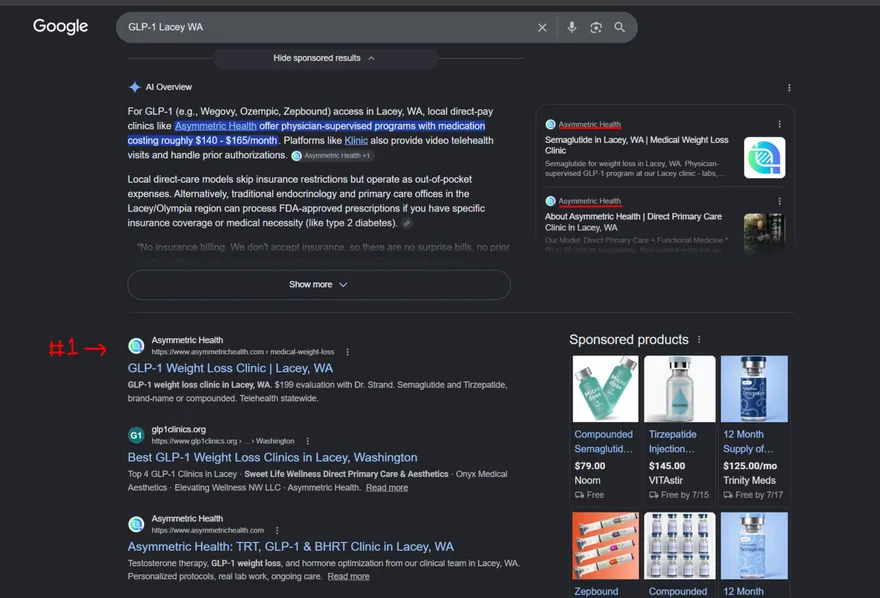
The benchmark we point to: Asymmetric Health, a physician-led cash-pay clinic in an adjacent specialty, reached #1 organic in 2 months on this program and is now recommended first, by name, in Google AI Overviews. We do not have a dermatology client yet, and this page will not pretend we do. Same program, applied to your specialty, with the derm-specific research done in discovery.
Hardly any agency is competing for these searches.
Look at the difficulty column. A score of 5 to 11 out of 100 means the agencies selling dermatology marketing have barely bothered to compete for the practices searching for it.
That tells you two things. First, dermatology is underserved by specialist marketers, which is why so many practices end up with a generic medical agency that treats Botox demand and psoriasis demand as the same audience. Second, low agency-side competition usually means the patient-side terms in your city are winnable too. We scope those during discovery, market by market.
| # | Search query | Monthly volume |
|---|---|---|
| 1 | dermatology marketing | 1,000 |
| 2 | dermatologist marketing | 590 |
| 3 | dermatology seo | 320 |
Data source: Semrush US database, fetched July 13, 2026. Difficulty is Semrush keyword difficulty (0 to 100). Patient-side demand for your market (condition, treatment, and "dermatologist near me" queries in your city) is scoped per engagement during discovery.
Two patients, two searches, two completely different opponents.
The acne patient and the Botox patient will never run the same search, never weigh the same signals, and never see the same competitors on the results page. Any dermatology marketing plan that does not start from that split is guessing.
The medical patient
Searches the condition, filters by insurance, books by availability
Acne, eczema, psoriasis, a mole that changed. This patient types "dermatologist near me" or the condition plus their city, and the Map Pack settles most of it: proximity, rating, and whether your profile says you take their insurance. Your competitors on this side are other dermatologists, hospital systems, and the directories.
Then comes the tiebreaker nobody optimizes for: who can actually see them. Dermatology wait times are a known industry sore spot, and patients respond by calling down the list. A profile with a live booking link and a site that states real availability wins against a better-rated practice that makes people phone the front desk to find out.
The cosmetic patient
Searches the treatment, pays cash, comparison-shops you against med spas
"Botox [city]". "Lip filler near me". "Laser resurfacing cost". No insurance filter, no referral, and the results page is wall-to-wall med spas, because cash-pay revenue funds marketing budgets. This patient reads pages, compares photos and reviews, and often never realizes a board-certified dermatologist was an option.
That last part is the opening. The med spa cannot match your credential; it can only hope patients never see it. A dedicated page per cosmetic treatment that names who does the injecting, backed by reviews that mention cosmetic visits, puts the credential in the comparison. Most practice websites bury it on an About page instead.
One page per procedure and per condition, in plain English. A single "Services" page listing forty offerings cannot rank for any of them, because Google matches pages to queries, and forty queries cannot all match one page.
The practices that own dermatology search results give acne its own page, skin checks their own page, Botox its own page, each written the way patients talk. It is unglamorous work and it is the most reliable ranking gain available to a dermatology practice.
What the program covers for a dermatology practice.
One monthly fee, one connected program. The pieces below reinforce each other, which is exactly why buying them from four different vendors produces four invoices and no result.
Procedure and condition page architecture
A dedicated page for every treatment and condition the practice wants patients for, medical and cosmetic, written around the searches patients run rather than clinical categories. This is where the ranking gains live, and it doubles as the raw material Google's AI Overview quotes from.
Google Business Profile built for both demand curves
Medical categories and the full service list so condition searches match, plus the cosmetic services listed explicitly so treatment searches do too. Photos, posts, Q&A, and a working booking link, because the profile is the storefront for every 'dermatologist near me' search in your radius.
Availability and booking signals
Wait-time shopping is real in dermatology, so we make availability visible: online booking wired into the profile and the site, and honest scheduling language on the pages patients compare. If you can see new patients faster than the practice across town, that fact should be doing marketing work.
Review generation that follows Google's rules
Every patient gets the same post-visit request. No filtering by sentiment, no incentives, because Google's content policy prohibits both and a policy strike costs a medical practice more than a slow month. Responses are written so no public reply ever confirms someone was a patient.
The cosmetic-side fight
Content and ad strategy aimed at the med spa competition specifically: treatment pages that lead with board certification, consented before-and-after galleries where the practice has them, and Google Ads managed so cash-pay campaigns stop bleeding budget into searches that never book.
HIPAA-conscious tracking and reporting
Monthly reporting tied to calls and booked appointments, not traffic charts. No patient identifiers in pixels, no condition-level browsing data handed to ad platforms, no third-party scripts on intake pages. Dermatology sites carry photo consent and remarketing risks most agencies never think about; we design around them.
We have not ranked a dermatologist yet. Here is what we have ranked.
Plenty of agencies would paper over that sentence. We would rather show you the nearest real evidence and let you judge the distance.
Asymmetric Health is a physician-led, cash-pay clinic: local competitors on one side, VC-funded national telehealth on the other, high-value elective treatments in the middle. Swap the treatment names and that is a cosmetic dermatology market. The numbers below are from the live engagement, and every one of them is documented in the public case study.
Time to #1
2 moWebsite rebuild plus a healthcare SEO program, from launch to #1 organic in 60 days
Organic rankings
#1The clinic's priority TRT, GLP-1, and peptide searches across its home market
AI Overview citation
1stGoogle's AI cites the clinic first, by name, with its pricing
Google map pack
Top 3Dominating the local pack at 5.0 stars, ahead of clinics based in Olympia
A local clinic out-ranking national telehealth organically in two months is the relevant precedent, because the cosmetic side of dermatology faces the same asymmetry: you against competitors with bigger ad budgets, decided by who Google trusts locally. What we are offering dermatologists is that program, applied to dermatology, with the specialty research done in discovery rather than assumed. You can also see the markets where we run it.
The five services inside a dermatology engagement.
Each has its own page with the full detail. For a dermatology practice, they get pointed at the medical-cosmetic split described above.
Healthcare SEO
The full organic program: condition and treatment content, technical work, and schema. For dermatology, this is what ranks the procedure page architecture.
See the full pageLocal SEO
The Map Pack work: Google Business Profile, healthcare citations, and reviews. Where 'dermatologist near me' gets won or lost.
See the full pageAI Search Optimization
Getting recommended by Google's AI Overview, ChatGPT, and Perplexity when patients ask for the best dermatologist in their city.
See the full pageWebsite Design
Hand-coded practice sites built around one-page-per-procedure architecture, online booking, and consented photo galleries that load fast.
See the full pageGoogle Ads / PPC
Cash-pay cosmetic campaigns are where derm ad budgets burn. Disciplined spend against the med spa bidders, with no patient data in ad platforms.
See the full pageThe first months, in four moves.
Map both demand curves
Medical and cosmetic demand get researched separately, because they behave separately. We pull the condition and skin-check searches in your catchment area, then the injectable and laser searches, and list who currently ranks for each: other dermatologists, hospital systems, directories, or med spas. Each opponent is beaten differently.
Fix the foundation
Site speed and indexability, MedicalClinic and Physician schema, and a Google Business Profile with the right medical categories, the full service list, photos, and a working booking link. If your profile does not say you offer skin cancer screenings, Google will not show you for them.
Build the page architecture
One plain-English page per procedure and per condition, written around what patients type rather than clinical taxonomy. Acne, eczema, psoriasis, mole checks on the medical side; Botox, fillers, and laser on the cosmetic side. This is the single highest-return piece of dermatology SEO and most practice sites skip it entirely.
Reviews, reporting, iteration
A post-visit review request that goes to every patient, never filtered by sentiment and never incentivized, because Google prohibits both. Monthly reporting tied to calls and booked appointments, with HIPAA-conscious tracking throughout: no patient data in pixels, nothing sensitive handed to ad platforms.
Other specialties we write for
What dermatology practice owners want settled first.
Dermatology marketing is the work of getting a dermatology practice found and booked for the searches patients actually run: "dermatologist near me" and condition-plus-city searches on the medical side, and treatment-plus-city searches like "botox [city]" on the cosmetic side.
In practice it covers the practice website, the Google Business Profile that powers the Map Pack, review generation, procedure and condition content, and paid ads where they make sense. The medical and cosmetic sides need different work because they face different competitors, which is the main thing generic medical marketing gets wrong about dermatology.
Very. Medical dermatology demand arrives through "dermatologist near me" and condition searches, gets filtered by insurance, and converts through the Map Pack and reviews. Cosmetic demand arrives through treatment searches, pays cash, and puts you in direct competition with every med spa and injector clinic in your market, most of which spend aggressively on ads.
One program has to fight both fights: local and organic SEO carries the medical side, while the cosmetic side leans on procedure pages, board-certified positioning, and disciplined ad spend.
Not on price, and not by out-bidding them forever. The med spa's pitch is convenience and cost; your pitch is that a board-certified dermatologist is doing or supervising the injecting.
That difference only works if patients can see it, which means a real page for each cosmetic treatment that says who performs it, a review base that mentions cosmetic visits, and ad copy that leads with the credential. Med spas can copy your prices. They cannot copy your board certification.
They decide it more often than reviews do. Dermatology wait times are a known industry pain point, and patients respond by calling two or three offices and booking whichever can see them first.
That behavior is a ranking-adjacent opportunity: a practice that publishes real availability, keeps a working online booking link on its Google Business Profile, and says "new patients seen within X weeks" on its site (only if true) wins the comparison against a higher-rated practice that makes patients call to find out. We build availability signals into the profile and the site as part of the program.
Not yet, and we would rather say that plainly than imply otherwise. What we have is the same program running in an adjacent specialty: Asymmetric Health, a physician-led cash-pay clinic, went from a fresh website launch to #1 organic for its priority searches in 2 months, and is recommended first, by name, in Google AI Overviews.
Cash-pay treatments, local competition, a national telehealth threat: the shape of that fight is the shape of the cosmetic dermatology fight. The program transfers; the specialty-specific research happens in discovery.
Map Pack movement typically starts within weeks of Google Business Profile work. Organic movement on condition and procedure pages usually shows in 1 to 3 months, faster when the site foundation is clean.
The adjacent-specialty benchmark: Asymmetric Health hit #1 organic in 2 months, on a full rebuild where the technical work was right from day one. If the schedule needs cosmetic patients this month, Google Ads runs while the SEO builds; that is why many engagements pair the two.
Dermatology has two extra exposure points beyond the usual.
- Before-and-after photos: the strongest cosmetic conversion asset a practice owns, and they only go on the site with documented patient consent, full stop.
- Remarketing: a tracking pixel that tags visitors of your psoriasis page and follows them around the internet can constitute a disclosure.
So we keep patient identifiers out of tracking, keep third-party scripts off intake pages, and configure ad platforms so no condition-level browsing data leaves your site. Your compliance officer reviews the setup before launch.
One monthly fee for the whole program: local SEO, organic SEO, AI search optimization, review generation, and reporting bundled together and quoted against your market and how contested your cosmetic terms are.
Website design is its own project, starting at $3,000+, with two payment options: pay upfront and the engagement runs 6 months, or spread the build across 12 months as part of the package.
Google Ads is a separate line only because the ad spend goes to Google, not to us. Exact numbers come after we look at your market.
Sources & data
- Semrush US database: keyword volume, keyword difficulty, and CPC for the three dermatology marketing queries in the table above. Fetched July 13, 2026. No other keyword figures appear on this page.
- Google Maps user-contributed content policy: the prohibition on review gating and incentivized reviews referenced in the review-generation sections. support.google.com/contributionpolicy/answer/7400114
- Asymmetric Health case study: the engagement record behind every client claim on this page: 2 months to #1 organic, #1 organic rankings across its priority searches, first-position AI Overview citations, #1 Olympia local pack at 5.0 stars. Asymmetric Health is an adjacent-specialty clinic, not a dermatology practice. savogroup.com/project/asymmetric-health
See which searches your practice is invisible for.
The free Dermatology SEO Report maps your Map Pack positions, your organic rankings for the medical and cosmetic searches in your market, your AI Overview visibility, and which med spas currently hold the cosmetic terms you should own. Send us your site, get the numbers back. No call required.