Optometry Marketing for the Independent Eye Doctor.
Optometry marketing is the work of putting an independent eye care practice in front of patients at the moment they search: "eye exam near me", a dry eye question, or a check on which local optometrist takes their vision plan. Online retail took a bite out of your optical.
It cannot refract an eye. This page covers how we win the searches that end in your exam chair, built on the same healthcare SEO program we run for medical practices nationwide.


See where your practice stands.
Send us your site. We'll pull your map pack positions, organic rankings, Google Business Profile health, and the AI answers patients in your market already see, then send the numbers back inside 24 hours. No call required.
Can an independent optometry practice still out-market online eyewear and big-box optical?
Yes, because the fight is not where most practice owners think it is. A glasses website and a warehouse club vision center can undercut your frame prices all day.
Neither one can appear in your city's Map Pack for "eye exam near me", hold a page that answers "optometrist that takes VSP" for your zip code, or treat the dry eye patient who has been researching her symptoms for a week. The exam drives the door. The exam is local. That is the ground an independent OD can own.
And optometry has a property most specialties would kill for: the recall cycle is built in. An annual exam means a patient won from search this year is not one visit, it is a visit every year, plus the contact lens supply, plus whatever walks out of the optical. Local rankings compound; so does every patient they bring in.
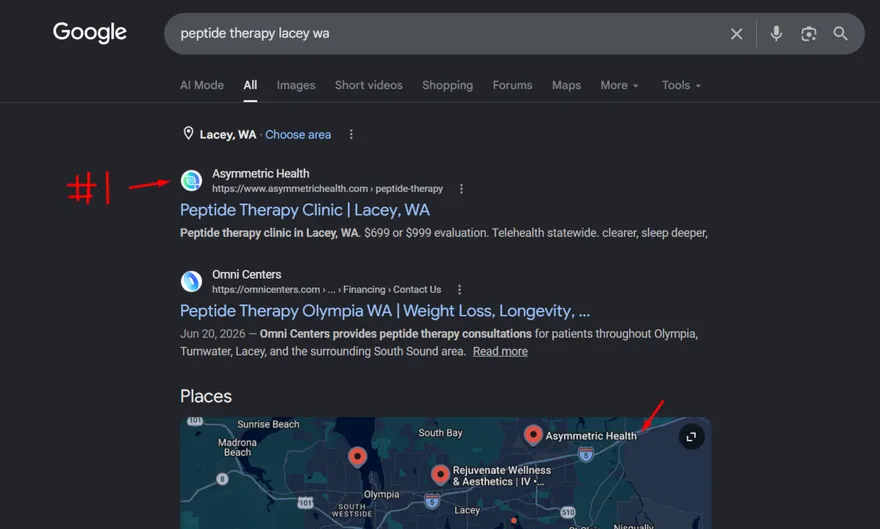
The program behind this page is live and measurable: Asymmetric Health, an independent physician-led clinic (a different specialty, and we say so plainly), reached #1 organic in 2 months against VC-funded national competitors, with Google AI Overview citations by name and the #1 local pack spot at 5.0 stars in a neighboring city.
Agencies pay $27.91 a click to reach you. That number is worth reading.
"Optometry marketing" gets 590 US searches a month, and a single Google Ads click on it costs $27.91. Nobody bids that on a small keyword unless the customer on the other end is worth serious money, which is a backhanded compliment to your practice: the marketing industry has priced in what an optometry retainer is worth.
We took the cheaper seat at that table. We rank for these phrases instead of renting them, and there is a fair chance that is exactly how you found this page.
| # | Search query | Monthly volume | CPC |
|---|---|---|---|
| 1 | optometry marketing | 590 | $27.91 |
| 2 | optometrist marketing | 390 | $15.27 |
| 3 | optometry seo | 260 | $25.27 |
| 4 | eye doctor marketing | 110 | n/a |
Data source: Semrush US database, fetched July 13, 2026. Difficulty is Semrush keyword difficulty (0 to 100). Across these four queries, 1,350 monthly searches. Patient-side demand in your market ("eye exam near me", vision plan queries, dry eye and myopia searches by city) is scoped per engagement during discovery.
Your optical is under siege. Your exam chair is not.
Every independent OD knows the math: the exam drives the door, the eyewear pays the bills. And the eyewear half has been getting carved up for a decade, first by online glasses retailers shipping direct, then by the optical counters inside warehouse clubs and retail chains selling frames at margins no independent dispensary should chase.
A marketing plan that pretends otherwise wastes your money. Ours starts by conceding the commodity frame war and winning everything else.
What online retail took
The commodity frame sale
A patient with a simple prescription and a saved PD can buy frames from a website at a price your dispensary cannot match. Chasing that sale with ads is setting money on fire. The honest play is capture rate: fill the exam schedule, and let your opticians do their work while the patient is standing eight feet from the frame wall.
What online retail cannot touch
Everything requiring your chair
The comprehensive exam. Dry eye evaluation and treatment. Myopia management for the kid whose prescription jumps every year. Contact lens fittings, especially specialty and scleral lenses. Diabetic eye exams and the referral relationships behind them. Every one of those is a local search with real volume in your market, and a checkout page cannot rank for a single one of them.
One more thing the chains cannot copy: the compounding. An annual recall cycle means the patient you win from search in March is back next March, and the March after.
Corporate optical spends its marketing budget building the retailer's brand; if you have ever worked a sublease inside one, you have watched that firsthand. An independent practice that owns its rankings owns the patient relationship, the recall, and the reviews those patients leave, and all three keep working after the invoice is paid.
The exam is won on Google before anyone reads a letter chart.
Watch how a new patient actually arrives and the marketing plan writes itself. There are three distinct search moments, and most optometry websites are built for none of them.
The exam search
"Eye exam near me", "optometrist near me", "eye doctor" plus the city. It happens on a phone, the Map Pack answers it, and the tap goes to whichever practice has the strongest profile and reviews within driving distance. Proximity matters, but a fully built profile beats a closer, emptier one; we have the local pack result to prove it.
The insurance check
"Optometrist that takes VSP" plus a city is about as high-intent as a healthcare search gets: the patient has a benefit and is deciding who gets it this year. Almost no practice site has a page built for that query. A logo strip on the contact page does not rank. A real page per vision plan does, and it converts.
The medical search
The dry eye sufferer researching her symptoms. The parent reading about myopia control after a second prescription jump. The diabetic told to get an annual eye exam. These patients search the problem, not your practice name, and the practice whose pages answer them becomes the practice they book with. Google's AI Overview quotes these pages too, and names practices by name.
Reviews run underneath all three moments. Whatever gets a patient to your listing, the star rating decides whether they tap it, which is why review generation is built into the program rather than sold as an add-on. Always by the rules: every patient asked, nobody screened by sentiment, nothing incentivized. The local SEO page covers the mechanics in detail.
The program, tuned for an optometry practice.
Same connected system we run for every medical client, one monthly fee, with the content map rebuilt around how eye care demand actually searches.
Google Business Profile built for eye care
Optometrist and eye care center categories, a services list that separates medical eye care from routine vision exams, insurance attributes, photos of the office and the optical, hours, and a booking link. This profile powers the Map Pack that answers the exam search, so it gets managed like the revenue asset it is.
Medical service pages online retail cannot answer
Dedicated pages for dry eye evaluation and treatment, myopia management, contact lens fittings including specialty and scleral lenses, and diabetic eye exams. Written around what patients type when they have the problem, because they search the symptom long before they search a practice name.
Vision plan pages
A page for each major panel you accept, built for the "optometrist that takes [plan]" search. What the plan typically covers, what the exam involves, how to book. High intent, almost zero competition, and the section of this program most practice websites are missing entirely.
Exam and city pages
Comprehensive eye exam pages for your city and the surrounding towns patients drive in from. The exam is the front door for everything else the practice sells, so these pages carry the local keyword targets and feed the recall cycle year after year.
Review generation inside Google's rules
A consistent post-visit request to every patient through your front desk workflow. No screening by sentiment, no incentives; Google's content policy bans both and an eye care practice has a recall relationship to protect. Response handling included, written so no public reply ever confirms someone was a patient.
HIPAA-conscious reporting
Monthly reporting on Map Pack positions, organic rankings, AI Overview citations, profile calls, and booked exams. Optometrists are covered entities, so tracking is configured accordingly: no patient identifiers in pixels, no form contents passed to ad platforms, nothing sensitive on booking pages.
We do not have an optometry case study yet. Here is the one we do have.
Asymmetric Health is a physician-led Direct Primary Care clinic specializing in TRT, GLP-1-assisted medical weight loss, and BHRT in Lacey, WA, serving 500+ patients. Not an eye care practice, and we would rather tell you that than let you assume otherwise.
What makes it relevant is the shape of the fight: an independent local clinic losing ground to VC-funded national competitors, which is the optometry story with the nouns changed. We rebuilt the site and ran the program on this page. The engagement is active; these numbers are current, not a retrospective.
Time to #1
2 moWebsite rebuild plus a healthcare SEO program, from launch to #1 organic in 60 days
Organic rankings
#1The clinic's priority TRT, GLP-1, and peptide searches across its home market
AI Overview citation
1stGoogle's AI cites the clinic first, by name, with its pricing
Google map pack
Top 3Dominating the local pack at 5.0 stars, ahead of clinics based in Olympia
The detail an OD should notice: the #1 local pack position in a city the clinic is not located in. Proximity is supposed to decide the Map Pack, and a fully built profile with a real review base beat it. That is the exact mechanism an independent optometry practice uses against the vision center inside a big-box store.
Read the case studyFive services, one optometry engagement.
Each has its own page with the full mechanics. On an optometry engagement they run together, and you can browse the markets where the program runs.
Healthcare SEO
The full organic program: technical foundation, content, and rankings across the Map Pack, organic results, and AI Overview.
See the full pageLocal SEO
The Map Pack work that answers "eye exam near me": Google Business Profile, citations, and review generation.
See the full pageAI Search Optimization
Getting your practice named when Google's AI, ChatGPT, or Perplexity answers "best eye doctor in [city]".
See the full pageWebsite Design
Hand-coded practice websites that load fast on a phone and turn exam searches into booked appointments.
See the full pageGoogle Ads / PPC
Fills the exam schedule while the rankings build, with no patient data leaking into ad platforms.
See the full pageFour phases, no mystery.
Map the market
We pull your current rankings, your Google Business Profile data, and the exam-intent searches in your catchment area. Then we look at who actually holds those results: the chain optical inside a retailer, the warehouse club's vision center, the other independents. Each competitor type loses to a different move, and an optometry market usually contains all three.
Fix the foundation
Site speed and indexability, then Optometrist and FAQPage schema, then the Google Business Profile itself: eye-care categories, a services list that separates medical eye care from routine exams, photos of the actual office and optical, and a booking link. Citations get matched across the directories patients actually check, name, address, and phone identical everywhere.
Build the pages patients search for
Exam pages for each city you pull patients from, medical service pages for dry eye, myopia management, specialty contact lens fittings, and diabetic eye exams, and a page for each major vision plan you accept. Every page is written around a query a real patient types, and structured so Google's AI Overview can quote it.
Compound it
A post-visit review request to every patient with no gating and no incentives, monthly content additions, profile posts, and reporting tied to calls and booked exams rather than traffic charts. Tracking stays HIPAA-conscious throughout: optometrists are covered entities, so no patient data goes anywhere near an ad platform.
What practice owners ask us about optometry marketing.
Optometry marketing is the combined work of local SEO, organic SEO, website design, review generation, and paid ads that puts an eye care practice in front of patients at the moment they search. For an independent OD that means three result types on one Google page:
- The Map Pack for "eye exam near me" and "optometrist near me"
- The organic results for medical and insurance queries
- The AI Overview that increasingly answers "best eye doctor in [city]" by naming specific practices
The retail half. No other specialty has a product wall in the lobby, and no other specialty has that product wall contested by online retailers and big-box optical. So the strategy weights differently: instead of fighting a price war you cannot win on frames, the marketing concentrates on the exam demand and the medical services that online retail cannot touch.
Vision plan searches are the other difference. "Optometrist that takes VSP" plus a city is a keyword class most specialties simply do not have, and it converts about as well as anything in healthcare.
Not head-on, and anyone who tells you otherwise is selling something. An online retailer will always beat a dispensary on the price of a commodity frame. What SEO does is fill the exam chairs, and optical capture happens in the office after the exam; that part belongs to your dispensary and your opticians, not to Google.
Where the website does fight for eyewear directly is the specialty side: scleral and other specialty lens fittings, myopia management lenses for kids, and prescriptions complex enough that a mail-order checkout flow cannot handle them.
Yes, and almost nobody does it. A patient typing "optometrist that takes VSP [city]" has a benefit they intend to use and is picking who gets it. Most practice websites answer that search with a logo strip on the contact page, which ranks for nothing.
A dedicated page per major panel, covering what the plan typically covers, what an exam involves, and how to book, ranks for the exact query and greets the patient with the answer they came for. We build one for each panel that matters in your market.
Map Pack movement typically starts within weeks of the Google Business Profile work. Organic rankings for local exam and insurance queries usually follow in 1 to 3 months when the site foundation is clean.
Our benchmark for the program is Asymmetric Health, a physician-led clinic in a different specialty, which went from website launch to #1 organic for its priority searches in 2 months. If the schedule needs filling before then, Google Ads covers the gap while the rankings build; many engagements run both.
Our anchor healthcare client is a physician-led Direct Primary Care clinic specializing in TRT, GLP-1-assisted medical weight loss, and BHRT, not an optometry practice, and we are not going to dress that up.
What we can show you is the same program run for another independent clinic against national, VC-funded competitors: #1 organic in 2 months, #1 positions, first-position Google AI Overview citations, by name, and the #1 local pack spot in a neighboring city at 5.0 stars.
The mechanics that produced those numbers, local exam-intent searches, medical service content, profile and citation work, and a compliant review base, are the same mechanics an optometry market runs on.
One monthly fee for the whole program: local SEO, organic SEO, AI search optimization, review generation, and reporting, quoted against your market and how many cities you pull patients from. We do not invoice it as six separate line items.
Website design is its own project, starting at $3,000+, with two payment options: pay upfront and the engagement runs 6 months, or spread the build across 12 months as part of the package. Google Ads is the only other separate line, because that spend goes to Google, not to us.
Optometrists are covered entities, so we treat your analytics the way we treat any medical client's: no patient identifiers in tracking pixels, no form contents passed to ad platforms, no third-party scripts on booking or intake pages that could see health information, and call tracking configured deliberately rather than left on defaults.
If your compliance requirements say something has to go, it goes. A diabetic eye exam inquiry is health information, and it gets handled like it.
Sources & data
- Semrush US database: keyword volume, keyword difficulty, and CPC for the four optometry marketing queries cited on this page. Fetched July 13, 2026. No CPC was returned for "eye doctor marketing", so none is shown.
- Google Business Profile guidelines: eligibility and representation rules for the profiles that power the Map Pack. support.google.com/business/answer/3038177
- Google Maps user-contributed content policy: the prohibition on review gating and incentivized reviews referenced in the review-generation sections. support.google.com/contributionpolicy/answer/7400114
- Asymmetric Health case study: the engagement record behind every client claim on this page: 2 months to #1 organic, #1 organic rankings across its priority searches, first-position AI Overview citations, #1 local pack at 5.0 stars. A physician-led clinic, not an optometry practice; this page says so wherever the numbers appear. savogroup.com/project/asymmetric-health
Marketing for other specialties
Find out who wins "eye exam near me" in your city right now.
The free Optometry SEO Report covers your Map Pack positions, organic rankings for the exam and vision plan searches in your market, AI visibility, profile health, and site speed, with what we would fix first. Send us your site, get the numbers back. No call required.