Plastic Surgery Marketing: Win the Months Before the Consult.
Plastic surgery marketing is the work of getting your practice found, vetted, and chosen during the longest research cycle in local healthcare: the months a patient spends searching "rhinoplasty cost [city]", "tummy tuck recovery", and "best plastic surgeon near me" before they ever request a consult. The core of it is plastic surgery SEO: procedure pages, a fast site, board certification Google can read, and reviews earned the allowed way.
This page covers what that program looks like for a surgical practice.


See where your practice stands.
Send us your site. We'll pull your map pack positions, organic rankings, Google Business Profile health, and the AI answers patients in your market already see, then send the numbers back inside 24 hours. No call required.
What actually grows a plastic surgery practice in 2026?
Owning the searches patients run during the research months, because by consult day the decision is mostly made. Plastic surgery is cash-pay, high-ticket, and elective, so nobody books it the way they book a strep test.
Patients compare surgeons at the procedure level for weeks or months, and every ranking your practice holds during that window ("rhinoplasty cost", "mommy makeover recovery", "breast augmentation before and after") is a compounding claim on the consults at the end of it.
Three assets decide who wins: procedure pages with honest cost and recovery answers (the content patients actually read), a fast site with a fast gallery (image weight is why most surgeon sites lose the speed contest), and board certification that machines can verify, since patients are told to check the American Board of Plastic Surgery credential and Google's AI now does that checking for them.
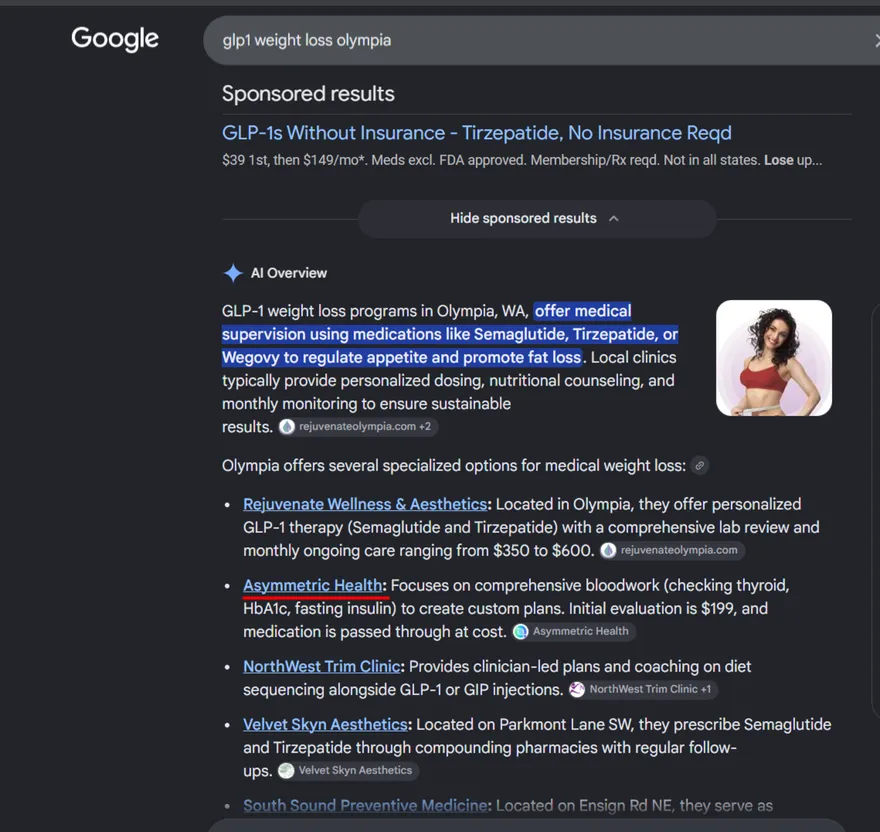
Our benchmark for cash-pay healthcare SEO: Asymmetric Health, a physician-led cash-pay clinic, went from site launch to #1 organic in 2 months against VC-funded national competitors, and Google's AI Overview now recommends it by name, citing its published pricing. Adjacent specialty, same economics; details below.
Surgeons run 5,180 searches a month for exactly this help.
These are practice owners searching for marketing help, not patients searching for surgeons. Notice the first row: a click on "plastic surgery seo" costs $27.74 on Google Ads. Agencies pay that because a surgical practice that ranks is worth a lot, and that same logic is why ranking beats renting. Patient-side demand for your procedures gets pulled during discovery.
| # | Search query | Monthly volume |
|---|---|---|
| 1 | plastic surgery seo | 2,400 |
| 2 | plastic surgery marketing | 1,900 |
| 3 | plastic surgeon marketing | 880 |
Data source: Semrush US database, fetched July 13, 2026. Difficulty is Semrush keyword difficulty (0 to 100). Procedure-level patient demand in your specific market is scoped per engagement.
Nobody impulse-buys a rhinoplasty.
An urgent care patient searches once and picks from the map. A surgical patient reads for months before a single practice name enters the picture. That research window is the whole game in plastic surgeon marketing: whoever keeps showing up while the patient is still deciding gets the consult when they finally are. Four things about the window shape everything we build.
The searches are about procedures, not practices
"Tummy tuck recovery", "breast augmentation before and after", "rhinoplasty cost" plus a city. Your name appears in almost none of the research-phase queries, so a site organized around your brand instead of your procedures is invisible for months of each decision. It also means honest cost and recovery pages compound harder here than in any other specialty, because the questions get asked so many times before anyone books.
Board certification is the vetting step, so make it machine-readable
Every consumer guide, and increasingly every AI answer, tells patients to verify certification by the American Board of Plastic Surgery. If that credential lives in a JPEG banner on your bio page, the engines answering "is Dr. [name] board certified" cannot extract it. Physician schema with the certification as structured data turns your strongest trust signal into something machines can quote.
Galleries convert, and galleries are why surgeon sites are slow
Before-and-after photos carry more decision weight than any testimonial. They are also, almost universally, why a surgeon's site takes five-plus seconds to load: hundreds of full-resolution images in a plugin nobody has touched since launch. Speed is a ranking input and an abandonment input. A gallery built with compressed formats and lazy loading keeps the persuasion and loses the penalty.
Your competition includes people who cannot do what you do
Med spas and non-surgeon injectors bid aggressively on the lighter procedures: Botox, fillers, non-surgical contouring. They cannot compete on surgical credentials, so they compete on ad spend. The counter is winning those searches organically with the credential argument they cannot make. Conceding the light procedures concedes the introduction to the surgical patient they often become.
What we build for a plastic surgery practice.
One program, one monthly fee, built around the research cycle described above. Each piece feeds the others; a procedure page ranks better because the profile and reviews back it, and the AI citations come from the same structured pages doing the organic ranking.
Procedure pages with real answers
A dedicated page for every procedure you want to grow, covering candidacy, honest cost information, recovery timelines, and what happens at the consult. Written to be quoted: this is the content Google's AI Overview extracts when someone asks what a procedure costs in your city.
Surgeon credibility, structured
Physician and MedicalClinic schema carrying your board certification, training, and procedures in machine-readable form, plus bio pages written for the “is this surgeon legit” check every patient runs. The credential you spent a decade earning should be verifiable by every engine that patients ask.
A gallery that does not sink the site
Before-and-after galleries rebuilt or configured for speed: modern compressed formats, lazy loading, and page structure that lets each procedure gallery reinforce its procedure page. Consent documentation required for every photo, alt text written for the procedure and never the patient.
Local SEO and reviews
Google Business Profile fully built and actively managed, consistent listings across Healthgrades, Zocdoc, Vitals, and RealSelf, and a review request that goes to every patient without sentiment filtering or incentives, both of which Google prohibits. Review responses written so no reply ever confirms who was a patient.
AI search optimization
The structured content and consistent data that get a practice cited by name in Google AI Overviews, ChatGPT, and Perplexity answers. In plastic surgery the certification check and the cost question are already moving into AI answers, so this is part of the base program, and it has its own page: AI SEO for doctors.
HIPAA-conscious measurement
Reporting on rankings, Map Pack positions, AI citations, calls, and consult requests rather than raw traffic. No tracking scripts on consult or photo-upload pages, no patient identifiers in pixels, nothing sensitive passed to ad platforms. Aesthetic medicine attracts privacy-sensitive patients; the analytics should respect that.
When paid demand makes sense (a new procedure line, a new location, a slow quarter), Google Ads for doctors runs alongside the SEO as its own line item. And if the current site cannot be made fast, we rebuild it. You can also browse the markets where we run this program.
Our proof comes from one lane over, and we will say that plainly.
We do not have a plastic surgery client yet. What we have is Asymmetric Health, a direct primary care clinic (trt, glp-1, bhrt) in Lacey, WA: physician-led, cash-pay, consult-driven, winning aesthetic-adjacent searches like GLP-1 weight loss and TRT against VC-funded national telehealth. Your economics, different procedure list. The engagement is live, so the numbers below are current rather than a retrospective.
Time to #1
2 moWebsite rebuild plus a healthcare SEO program, from launch to #1 organic in 60 days
Organic rankings
#1The clinic's priority TRT, GLP-1, and peptide searches across its home market
AI Overview citation
1stGoogle's AI cites the clinic first, by name, with its pricing
Google map pack
Top 3Dominating the local pack at 5.0 stars, ahead of clinics based in Olympia
The detail that should interest a surgeon most: Google's AI Overview recommends the clinic by name and cites its published pricing. Cash-pay patients ask AI what things cost now, and the practices with extractable answers are the ones getting named. That mechanism transfers to rhinoplasty and tummy tuck queries directly.
Read the case studyPlastic surgery marketing, broken into its parts.
This page describes the program as a surgeon sees it. Each underlying service has its own detailed page.
Healthcare SEO
The full organic program: technical work, content, and rankings across the Map Pack, organic results, and AI answers.
See the full pageLocal SEO
Google Business Profile, healthcare directory citations, and review generation. The Map Pack work specifically.
See the full pageAI Search Optimization
Getting recommended by Google AI Overviews, ChatGPT, and Perplexity when patients ask for the best surgeon in town.
See the full pageWebsite Design
Hand-coded medical sites that stay fast with a full before-and-after gallery on board.
See the full pageGoogle Ads / PPC
Paid demand for new procedure lines and new locations, run without patient data leaking into ad platforms.
See the full pageTalk it through first
Tell us which procedures you want to grow and we will tell you what the search demand looks like in your market.
Contact usOther specialties we write for
Four phases, procedure-first from day one.
Procedure demand mapping
Before anything gets built, we pull the actual search demand for every procedure you perform, in your market: volumes for the cost queries, the recovery queries, and the comparison queries, plus who holds each result today. For a surgical practice that ranking research doubles as a business decision, because it tells you which procedures have patient demand your competitors have not claimed.
Site and profile foundation
Technical cleanup with special attention to image weight, since galleries are usually why surgeon sites load slowly. Physician and MedicalClinic schema that makes your board certification machine-readable, a fully built Google Business Profile, and consistent listings on the directories patients actually check, RealSelf included alongside Healthgrades and Zocdoc.
Procedure page build-out
One real page per procedure, written to answer what researchers ask: candidacy, honest cost information, recovery timelines, and what the consult covers. These pages do the ranking and the pre-selling. City pages extend reach into the markets patients travel from, because surgical patients routinely drive past nearer options for the right surgeon.
Reviews, reporting, iteration
A post-consult and post-procedure review request that goes to every patient, never filtered by sentiment and never incentivized, because Google prohibits both. Monthly reporting counts consult requests and calls, not traffic. Tracking stays HIPAA-conscious throughout: no patient identifiers in pixels, nothing from photo uploads or consult forms passed to ad platforms.
What surgeons ask us before signing anything.
Plastic surgery SEO is the work of ranking a practice for the searches patients run during a research cycle that can stretch across months: procedure-plus-city queries ("rhinoplasty cost Denver"), recovery and candidacy questions, "best plastic surgeon near me", and the board-certification checks that come right before someone books a consult.
It spans the Map Pack, the organic results, and the AI answers that now sit above both. Plastic surgery marketing is the broader program wrapped around that SEO: the website, the reviews, the ads when you want them.
Because the research window is longer. Someone with a broken tooth calls whoever ranks today. Someone considering a tummy tuck reads for months: cost, recovery, candidacy, surgeon comparisons.
Every one of those reads is a search your site can win, and a procedure page that ranks keeps meeting new researchers every month without new spend. A one-paragraph "Body Procedures" page cannot do that work. A real page per procedure, with honest cost and recovery information, can.
Publish something honest, even if it is a starting figure with the variables explained. "Cost" is one of the highest-volume modifiers in plastic surgery search, and pages that dodge the question lose the ranking to RealSelf and to competitors who answer it.
There is also a newer reason: AI answers reward published numbers. Google's AI Overview cites our cash-pay client Asymmetric Health by name partly because the clinic publishes its pricing. Surgeons worry a published figure scares patients off; in practice it filters out the consults that were never going to book.
Organically, with the asset they cannot copy. Med spas and non-surgeon injectors crowd the paid results for Botox and filler queries because ads are the only demand channel they have. A board-certified plastic surgeon can make a case they cannot: an injector who can also operate is the safer choice.
Content that argues it, schema that makes the certification machine-readable, and a review base earned over years will outrank an ad budget, and the injectable patient you win organically is often a surgical patient later.
They help conversions enormously and hurt rankings only when they are built badly, which is most of the time. Full-resolution photos dumped into a plugin are why so many surgeon sites take six seconds to load, and page speed is a ranking input.
Built correctly (compressed modern formats, lazy loading, real page structure around the images), a gallery is an asset on both fronts. Two non-negotiables from us: every photo published with documented patient consent, and alt text written for the procedure, never for the patient.
Yes, and plastic surgery is exactly the specialty where the defaults are dangerous. A consult form with photo upload is health information; it must never pass through ad-platform pixels or third-party scripts. We keep tracking scripts off intake and photo-upload pages, keep patient identifiers out of analytics, and configure call tracking deliberately. If your compliance reviewer wants something removed, it gets removed.
Not yet, and we would rather tell you that than imply otherwise. Our closest engagement is Asymmetric Health, a physician-led cash-pay clinic competing for aesthetic-adjacent searches (GLP-1 weight loss, TRT) against VC-funded national companies. Same economics as your practice: cash-pay, high-ticket, consult-driven.
That engagement reached #1 organic in 2 months and got the clinic recommended by name in Google's AI Overview. The free SEO Report exists so you can judge the method on your own rankings before anything is signed.
One monthly fee covering the whole program: local SEO, organic SEO, AI search optimization, review generation, and reporting. No separate invoices for content or review software or dashboards. The fee is quoted against your market and the procedures you want to grow, which is what the first call establishes.
Website design is its own project, starting at $3,000+, paid one of two ways: upfront with a 6-month engagement, or spread across 12 months as part of the package. Google Ads is the only other separate line, because that budget goes to Google rather than to us.
Sources & data
- Semrush US database: keyword volume, keyword difficulty, and CPC for the three plastic surgery marketing queries cited on this page. Fetched July 13, 2026.
- American Board of Plastic Surgery: the certifying board patients are advised to verify before choosing a surgeon; the credential referenced throughout the structured-data sections. abplasticsurgery.org
- Google Maps user-contributed content policy: the prohibition on review gating and incentivized reviews referenced in the review-generation sections. support.google.com/contributionpolicy/answer/7400114
- Asymmetric Health case study: the engagement record behind every client claim on this page: 2 months to #1 organic, #1 organic rankings across its priority searches, first-position AI Overview citations, #1 Olympia local pack at 5.0 stars. Adjacent cash-pay specialty; we state on this page that we have no plastic surgery client yet. savogroup.com/project/asymmetric-health
See what a researching patient finds when they look for you.
The free Plastic Surgery SEO Report maps your rankings for the procedure, cost, and "best surgeon" searches in your market, checks your site speed and gallery weight, and shows whether your board certification is readable by Google and the AI engines. Send us your site, get the numbers back. No call required.