Urgent Care Marketing: Be the Clinic Patients Pick From the Parking Lot.
Urgent care marketing is the work of winning the fastest decision in healthcare: a patient on a phone typing "urgent care near me" or "urgent care open now" and driving to whichever clinic looks open, close, and trustworthy within the next two minutes. The Google Business Profile wins that first click. The website wins the insurance and service questions behind it. This page covers the whole program, multi-location groups included.


See where your practice stands.
Send us your site. We'll pull your map pack positions, organic rankings, Google Business Profile health, and the AI answers patients in your market already see, then send the numbers back inside 24 hours. No call required.
What actually decides which urgent care a patient picks?
For the first visit, the Google Business Profile decides, not the website. "Urgent care near me" is the highest-immediacy search in healthcare: it happens on a phone, often from a car, sometimes with a sick kid in the back seat.
The patient scans the map for three things: open right now, close enough, and reviews that do not scare them. Hours, wait info, photos, and rating settle the choice before your homepage ever loads.
The website earns everything after that scan: "does urgent care do stitches", "urgent care X-ray cost without insurance", which plans you take, whether to skip the ER. Those get answered by pages, and the same pages are what Google's AI Overview and ChatGPT quote when patients ask instead of search.
The demand side is unusually open. "Urgent care marketing" draws 880 US searches a month at a keyword difficulty of just 9. "Urgent care seo" draws 210 a month at a difficulty of 0: on Semrush's 0-to-100 scale, literally uncontested.
Nobody is competing for "urgent care seo". We checked.
Two head phrases, and the second is the interesting one. Semrush keyword difficulty runs 0 to 100, and zero means no measurable competition at all: agencies have simply not bothered to contest "urgent care seo". Meanwhile a single click on "urgent care marketing" costs $13.98 on Google Ads, so somebody clearly thinks reaching you is worth paying for.
| Search query | Monthly volume | Difficulty |
|---|---|---|
| urgent care marketing | 880 | 9 |
| urgent care seo | 210 | 0 |
Data source: Semrush US database, fetched July 13, 2026. Difficulty is Semrush keyword difficulty (0 to 100). Semrush reports no CPC for "urgent care seo" because too few advertisers bid on it. Patient-side demand ("urgent care near me", service and cost queries in your specific market) is scoped per engagement.
Three screens between a symptom and your front door.
Most healthcare marketing assumes a patient who researches for weeks. Urgent care gets someone with a swollen ankle who needs a decision before lunch. The path runs through three screens, each a different piece of the program.
The search
"Urgent care near me, open now"
Typed on a phone, frequently from a parking lot or the school pickup line. Google answers with the map, and the map is built entirely from Google Business Profiles. Your website is not on this screen at all.
The profile
Open, close, and not scary
Hours, star rating, review recency, wait info, and photos of the actual clinic decide the drive. A 4.7 that is open beats a 4.9 that closes in twenty minutes. This screen is where urgent care visits are won and lost.
The website
The questions before the drive
"Does urgent care do stitches?" "X-ray cost without insurance?" "Do they take my plan?" Pages that answer these win the patients who check first, and they are the exact pages AI answers quote when patients ask a chatbot instead.
Wrong hours are the most expensive data error in urgent care. A patient who drives to a locked door sits in your parking lot and writes the one-star review that haunts the listing for years, and every future searcher reads it while deciding.
The dangerous errors are rarely the weekly schedule; they are the holiday close, the early Sunday close, the afternoon a provider called out. So we treat hours as live data across every location's profile, website, and schema markup, because no content strategy outranks "drove here, it was closed."
You are not really competing with the urgent care across town.
Where would your walk-ins otherwise go? The emergency room, the hospital's own urgent care, the clinic inside a pharmacy, or a telehealth app. Each one loses to a different piece of the work.
The emergency room
Patients searching "urgent care X-ray cost without insurance" are running from an ER bill. Plain pages about what you treat and how billing works catch them mid-flight. The ER cannot publish a price a patient believes; you can publish clarity.
Hospital-owned urgent care
The health system brings a huge domain and a known brand, but its profile is often an afterthought managed three counties away. An independent clinic with a fully built profile, fresh photos, and this week's reviews beats brand recognition on the map screen.
Retail clinics inside pharmacies
Convenient, but narrow: no stitches, no X-ray, limited pediatrics. Service pages about exactly those capabilities capture every case the pharmacy clinic turns away, plus the searchers who already know they need more than a strep test.
Telehealth apps
They skim the lightest cases: rashes, refills, sniffles. Anything needing hands, imaging, or a same-hour visit is structurally yours, provided your listing proves you are open and your site says you handle it today.
A second location does not double the work; it changes the architecture. Each clinic needs its own Google Business Profile (own hours, own photos, own review stream) and its own location page with genuine differences: the providers at that site, the services available there, the neighborhoods it draws from, where to park.
Clone one page five times and swap the city name, and Google sees five pages fighting over one query; they split the signals and the hospital system takes the position all five wanted. We build per-location pages that could not be mistaken for each other, then use internal linking to declare which page owns which city.
What the program covers for an urgent care clinic.
One monthly fee, one connected system. The profile work, the service content, the review flow, and the reporting reinforce each other, so we run them together instead of selling them as separate line items.
Google Business Profile with an hours discipline
Full build-out per location: urgent care categories, service list, insurance attributes, booking links, photo cadence, Q&A. Hours get managed as live data, holiday and exception closes included, because for urgent care the profile is the storefront.
Service and cost content
Pages for the searches patients run before choosing you over the ER or the pharmacy clinic: stitches, X-rays, pediatric visits, occupational health, what self-pay looks like. Written to answer the question, structured so AI answers can quote it.
Per-location pages that do not cannibalize
Each clinic gets a genuinely distinct page with its own providers, services, and neighborhood detail, plus its own profile. Internal linking assigns each city to one page so your locations rank side by side instead of splitting each other's signals.
Reviews by the rules
A post-visit request that goes to every patient. Never filtered by sentiment, never incentivized; Google's content policy prohibits both and an urgent care cannot afford a policy strike on the listing that feeds it patients. Response handling never confirms anyone was a patient.
Schema and AI answer eligibility
MedicalClinic and FAQPage markup per location, with openingHoursSpecification kept synchronized to the real schedule. This is the mechanical work that lets Google's AI Overview cite your clinic when a patient asks whether urgent care can treat what they have.
HIPAA-conscious reporting per location
Monthly numbers on calls, direction requests, and visits for each clinic, not blended traffic charts. No patient identifiers in pixels, no intake data touching ad platforms, call tracking configured with your compliance requirements up front.
Our proof is adjacent, and we will say so plainly.
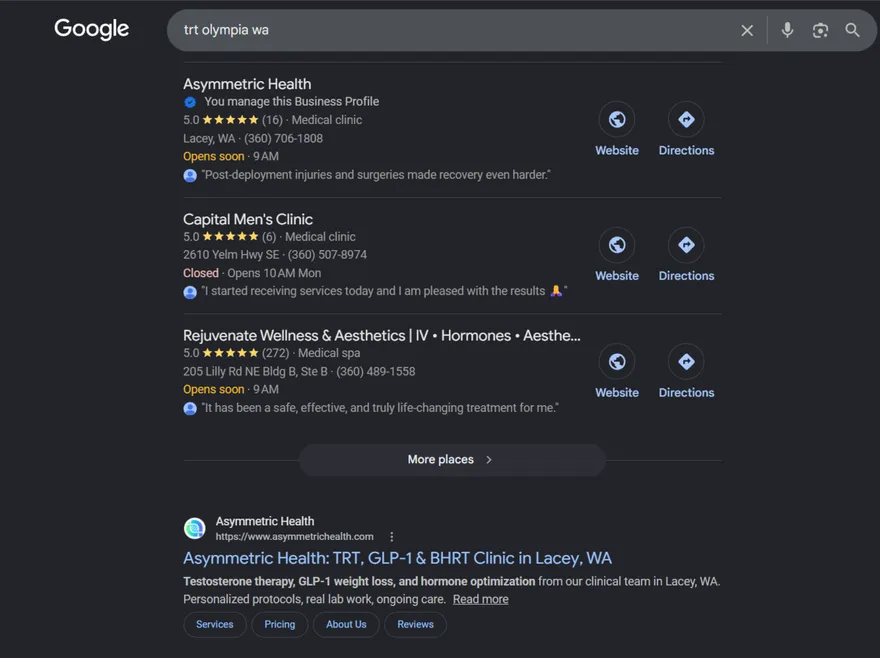
We do not have an urgent care client yet. No stock-photo logo wall, no "a leading urgent care group" with the name conveniently withheld. What we have is Asymmetric Health, a physician-led direct primary care clinic (trt, glp-1, bhrt) in Lacey, WA, that came to us losing local patients to VC-funded national telehealth companies.
Two months after the rebuild and SEO program launched, it was #1 organic for its priority searches with the top local map spot. Different specialty, same fight an urgent care runs every day: a local clinic beating bigger-budget competitors on proximity, profile, and reviews.
Time to #1
2 moWebsite rebuild plus a healthcare SEO program, from launch to #1 organic in 60 days
Organic rankings
#1The clinic's priority TRT, GLP-1, and peptide searches across its home market
AI Overview citation
1stGoogle's AI cites the clinic first, by name, with its pricing
Google map pack
Top 3Dominating the local pack at 5.0 stars, ahead of clinics based in Olympia
The engagement is active; these numbers are current, not a retrospective. If the mechanism holds for a hormone clinic against national telehealth, it holds for an urgent care against a hospital system.
Read the case studyFive services, weighted for how urgent care actually gets found.
Every specialty draws on the same five services; what changes is the mix. For urgent care, the local work carries most of the load and everything else supports it.
We run city-level programs across the country; browse the markets or ask about yours.
Four moves, in order.
Market read
We pull the map results a patient sees for "urgent care near me" around each of your locations, check every listing's hours against reality, read your review standing next to the hospital-owned clinic and the pharmacy clinic in your area, and measure the service searches (stitches, X-ray, cost, insurance) your site currently misses.
Profile and hours foundation
Each location gets its own fully built Google Business Profile: correct medical categories, service list, insurance attributes, photos of the actual waiting room, and an hours discipline that covers holidays and early closes. Hours get synchronized across the profile, the website, and the schema markup so no listing ever contradicts the front door.
Service and location pages
Pages for the questions patients research before choosing you over the ER or a pharmacy clinic: what you treat, what an X-ray or stitches visit involves, which insurance you take, what self-pay looks like. Multi-location groups get genuinely distinct per-location pages so Google knows which page owns which city.
Reviews and reporting
A post-visit review request that goes to every patient, never filtered by sentiment and never incentivized, because Google's content policy prohibits both. Monthly reporting counts calls, direction requests, and booked visits per location, with HIPAA-conscious tracking throughout: no patient data in pixels, nothing sensitive passed to ad platforms.
What urgent care operators ask us.
The work of winning two very different searches. The first is "urgent care near me" or "urgent care open now", typed on a phone by someone who will pick a clinic within minutes; the Google Business Profile wins that one with hours, reviews, photos, and distance.
The second is the research search ("does urgent care do stitches", "urgent care X-ray cost without insurance"), and the website wins that one. A complete program covers both, plus review generation and, when you need volume faster, Google Ads.
Because of how fast the decision happens. No other search in healthcare carries the immediacy of "urgent care near me": it comes from a phone, often from a car, and the patient commits to a drive before any website loads.
What they scan is the map listing itself: open right now, close enough, rating that does not scare them, photos that look like a real clinic. The website matters for the slower research searches and for AI answers, but the first visit from a "near me" search is decided on the profile.
A patient drives to a closed clinic, stands at a locked door, and writes the one-star review that sits on your listing for years. Wrong hours are the most expensive data error an urgent care can have online.
The errors are usually not the regular schedule; they are the holiday close or the day a provider called out. Our program keeps the profile, the website, and the schema markup for every location synchronized, with exceptions pushed the day you know about them.
By making each location genuinely distinct online instead of cloning one page five times. Each clinic gets its own Google Business Profile with its own hours, photos, and review stream, and its own location page with real differences: providers, services at that site, neighborhoods, parking. Internal linking then tells Google which page answers which city.
Skip that and the locations cannibalize each other: near-identical pages split the ranking signals for one query, and the hospital-owned clinic takes the spot both of them wanted.
Yes, because the patient choosing between you and an emergency room is running a cost calculation you can answer in public. Someone searching "urgent care X-ray cost without insurance" is trying to dodge an ER bill; a page that says plainly what you treat and how billing works wins that patient.
Pharmacy clinics lose on scope (no stitches, no X-rays), so pages about those exact services capture the cases they turn away. Telehealth takes the lightest cases; anything needing hands, imaging, or a same-hour visit is yours if your listing shows you are open.
Not yet, and we would rather tell you that than invent a logo wall. Our anchor healthcare client is Asymmetric Health, a physician-led Direct Primary Care clinic specializing in TRT, GLP-1-assisted medical weight loss, and BHRT: a different specialty running the same fight.
Two months in, it was #1 organic for its priority searches with the top local map spot, ahead of VC-funded national telehealth companies. The mechanism (proximity, a fully built profile, reviews, service pages) is exactly what an urgent care competes on. The case study is public; judge it yourself.
One monthly fee, quoted against your market and the number of locations. Local SEO, organic SEO, AI search optimization, review generation, and reporting are bundled into that single fee rather than invoiced as five separate line items.
Website design is its own project, starting at $3,000+, with two payment options: pay upfront and the engagement runs 6 months, or spread the build across 12 months as part of the package. Google Ads is the only other separate line, because that spend goes to Google, not to us.
Yes, and it has to be, because urgent care sites collect symptoms and insurance details at intake. Concretely: no patient identifiers in tracking pixels, no form contents passed to ad platforms, no third-party scripts on check-in pages, and call tracking configured deliberately rather than left on defaults. Your compliance requirements get reviewed before anything goes live.
Sources & data
- Semrush US database: keyword volume, keyword difficulty, and CPC for "urgent care marketing" and "urgent care seo", the only urgent-care keyword figures cited on this page. Fetched July 13, 2026.
- Google Business Profile guidelines: eligibility and representation rules for the profiles that power the "near me" map results. support.google.com/business/answer/3038177
- Google Maps user-contributed content policy: the prohibition on review gating and incentivized reviews behind our review-generation rules. support.google.com/contributionpolicy/answer/7400114
- Asymmetric Health case study: the engagement record behind every client claim here: 2 months to #1 organic, #1 organic rankings across its priority searches, first-position AI Overview citations, #1 Olympia local pack at 5.0 stars. A physician-led clinic, not an urgent care; the page above says so wherever it is cited. savogroup.com/project/asymmetric-health
Marketing programs for other specialties
See what "urgent care near me" shows in your market right now.
The free SEO Report covers your map position around each location, hours consistency across the web, your review standing, the service and cost searches your site is missing, and site speed, with what we would fix first. Send your locations, get the numbers back. No call required.