Orthodontist Marketing Built Around the Free Consult.
Orthodontist marketing is the work of getting your practice found and chosen during the weeks a family spends researching braces or aligners, so the consult calendar fills with cases instead of clicks. Treatment runs thousands of dollars, it is usually financed, and the free consult is where all of it gets decided.
So the website, the rankings, the reviews, and the ads on this page all point at one event: a booked consult.


See where your practice stands.
Send us your site. We'll pull your map pack positions, organic rankings, Google Business Profile health, and the AI answers patients in your market already see, then send the numbers back inside 24 hours. No call required.
Why does an orthodontic practice need its own marketing program instead of generic dental marketing?
Because orthodontics is a considered purchase that happens in search, weeks before anyone calls you. A case costs thousands of dollars, gets financed, and starts with a free consult, so families comparison-shop the way they would for a car: cost searches, "Invisalign vs braces" comparisons, review reading, and before and after browsing.
The practice that shows up with honest answers during that research phase gets the consult. The practice with a brochure site gets skipped.
Two more things make orthodontic marketing its own discipline. You have two distinct buyers, a parent researching for a kid and an adult researching aligners for themselves, and they search differently. And the direct-to-consumer aligner companies spent years teaching patients to comparison-shop treatment online, which permanently raised the bar for what an orthodontist's website has to answer.
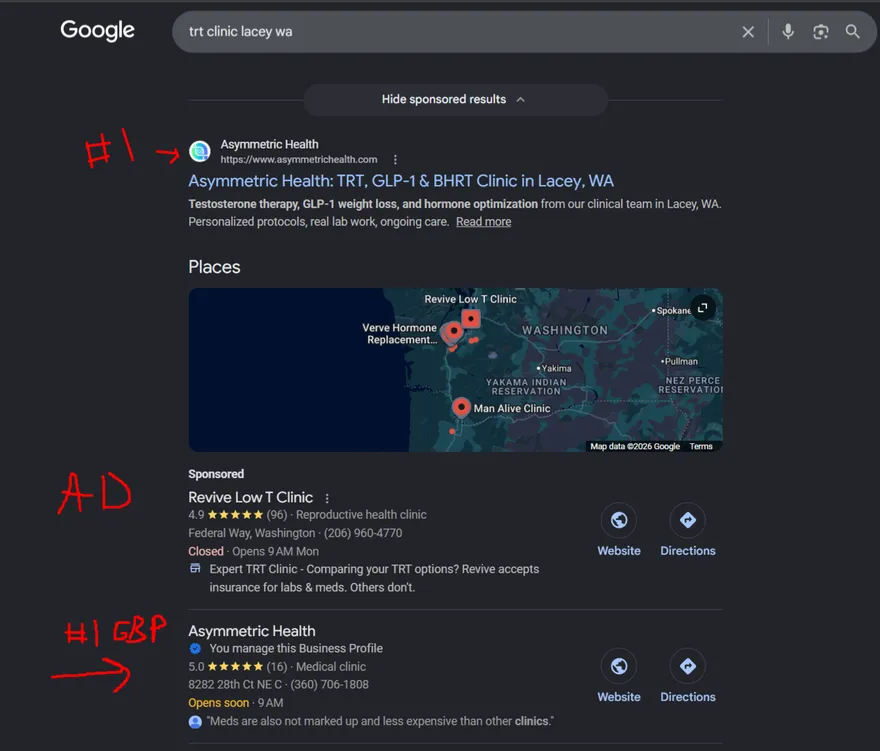
Our working benchmark comes from an adjacent specialty: Asymmetric Health, a physician-led cash-pay clinic where the consult is also the conversion event, went from website launch to #1 organic in 2 months and now holds Cited by name in Google AI Overviews. This page is that program, applied to how families choose an orthodontist.
What orthodontic practices pay to be found for.
These are the agency-side searches: practice owners and office managers looking for marketing help, 1,660 times a month across the three phrases. Note the CPC column.
When a click on "orthodontist seo" costs almost twenty-nine dollars, that is the market telling you what a ranked orthodontic practice is worth. The patient-side demand in your own market, the braces cost and aligner comparison searches, gets scoped during discovery because it varies city by city.
| # | Search query | Monthly volume |
|---|---|---|
| 1 | orthodontic marketing | 590 |
| 2 | orthodontist seo | 590 |
| 3 | orthodontist marketing | 480 |
Data source: Semrush US database, fetched July 13, 2026. Difficulty is Semrush keyword difficulty (0 to 100). Patient-side demand for your specific market is scoped per engagement during discovery.
Nobody picks an orthodontist on impulse.
A two-year treatment that shows on your face and costs as much as a used car does not get decided from a billboard. It gets decided over weeks of searching, and the research follows a pattern you can build a practice around.
Start with who is searching. The parent researching for a kid does it in the evening, on a phone, after the pediatric dentist mentioned a referral. She reads reviews the way she reads them for a pediatrician, because she is choosing someone her child will see every six weeks for two years.
The adult researching aligners for himself does it differently: he has probably already seen mail-order aligner pricing, he wants to know why an orthodontist costs more, and he wants to book online without a phone call. One practice, two completely different search sessions, and your site has to convert both.
Then look at what they type. The research phase is dominated by two query families: "how much do braces cost" and "Invisalign vs braces", in a dozen phrasings each. Most practices refuse to touch either topic online, reasoning that every case is different. True, and also beside the point.
The family is going to read a cost answer somewhere. Practices that publish an honest range for their market and a real financing page get into the comparison set; practices that hide pricing get filtered out before the consult stage, without ever knowing they were considered.
The direct-to-consumer aligner brands made this worse for everyone, and better for practices willing to compete. They spent enormous ad budgets teaching patients that orthodontic treatment can be shopped online, with prices on the page and a signup flow.
Patients kept the habit. So when they land on an orthodontist site with no costs, no cases, and a contact form that emails the front desk, the comparison is not against the practice down the street anymore. It is against a checkout page.
Last, the proof layer. Before and after cases and Google reviews carry more weight in orthodontics than in almost any specialty, because the result is visible, on your face, for years.
A 4.9-star profile with two hundred reviews and a gallery of real local cases will beat a bigger competitor with a thin profile in nearly every head-to-head a parent runs. Which is why review generation, done inside Google's rules, is a core line item in this program and not an afterthought.
The orthodontist marketing program, piece by piece.
Everything below runs under one monthly fee, because the pieces only work as a system. A cost page without reviews is unconvincing; reviews without rankings go unread.
A consult-first website
Every treatment page, cost page, and city page funnels to the consult request, and the form works on a phone at 10 PM because that is when parents fill it out. If the current site cannot support that, we rebuild it hand-coded; see the website design page for how those projects run.
Cost, financing & comparison content
The braces cost page, the Invisalign versus braces comparison, and a financing page that explains monthly payments in plain English. These are the highest-intent searches in orthodontics and the ones your competitors are most afraid to answer.
Local SEO for both buyers
Google Business Profile built out with orthodontic categories and treatments, citations matched everywhere, and city pages for the suburbs families drive in from. The parent searching "orthodontist near me" finds you in the Map Pack; the adult comparing aligners finds you in organic.
Before & after galleries that rank
Real local cases with documented marketing consent, built as structured pages with schema instead of a slideshow widget. They pull double duty: proof for the family already on your site, and rankings for the treatment searches that bring the next one.
Review generation inside the rules
A consistent post-appointment request to every family. No sentiment filtering, no incentives, because Google prohibits both and an orthodontic practice lives on its review profile for a decade. Response handling included, written so no reply confirms who is a patient.
HIPAA-conscious tracking & reporting
Consult requests and calls counted, no patient identifiers in tracking pixels, and nothing about a minor passed to an ad platform. Monthly reporting shows consults booked, not a traffic chart, because a traffic chart never straightened a tooth.
We have not ranked an orthodontist yet. Here is the closest thing.
Plenty of agencies would blur that sentence. We would rather show you the program running in an adjacent specialty with the same economics. Asymmetric Health is a direct primary care clinic (trt, glp-1, bhrt) in Lacey, WA: physician-led, cash-pay, consult-driven, and competing against VC-funded national telehealth brands the way you compete against national aligner brands. The engagement is active, started in 2026, and these numbers are current.
Time to #1
2 moWebsite rebuild plus a healthcare SEO program, from launch to #1 organic in 60 days
Organic rankings
#1The clinic's priority TRT, GLP-1, and peptide searches across its home market
AI Overview citation
1stGoogle's AI cites the clinic first, by name, with its pricing
Google map pack
Top 3Dominating the local pack at 5.0 stars, ahead of clinics based in Olympia
A local clinic out-ranking national competitors organically in two months is the mechanism that matters here, because the aligner brands bidding on your patients have the same structural weakness the telehealth companies had: no office in your city, no local reviews, no Map Pack presence. The program above is the same one, mapped onto orthodontic search behavior.
Read the case studyFive services, one orthodontic program.
Each piece of the orthodontist marketing program has its own detailed page. Read the ones that match where your practice is stuck.
Healthcare SEO
The full organic program: ranking the site for cost, comparison, and treatment searches across organic results and AI answers.
Read the Healthcare SEO pageLocal SEO
The Map Pack work: Google Business Profile, citations, and reviews. The fastest lever for "orthodontist near me" searches.
Read the Local SEO pageAI Search Optimization
Getting recommended by name when a parent asks Google AI or ChatGPT for the best orthodontist in your city.
Read the AI Search Optimization pageWebsite Design
Hand-coded practice sites built around consult booking, starting at $3,000+. The reference build ranked in two months.
Read the Website Design pageGoogle Ads / PPC
Consults this month while the SEO compounds, with no patient or minor data leaking into ad platforms.
Read the Google Ads / PPC pageWhere we run it
One orthodontic practice per market. Check whether your city is open, or ask us directly.
Four phases from signed to consults.
Map the market
We pull your rankings, your Google Business Profile data, and the consult-driving searches in your area: braces cost, Invisalign for adults, orthodontist near me, and the comparison queries parents run at night. Then we look at who holds those results now. Usually it is a mix of other practices, a DSO with a marketing department, and aligner-brand content, and each one is beaten differently.
Fix the foundation
Site speed, indexability, and Dentist plus FAQPage schema with the orthodontics specialty declared. Google Business Profile built out completely: categories, treatments, photos of the actual office, and a booking link that goes straight to the consult request. Citations matched across the directories parents actually check.
Publish what families are searching
Cost and financing pages with honest ranges, an Invisalign versus braces comparison written like you would explain it chairside, treatment pages for kids, teens, and adults, and city pages for the suburbs families commute from. Every page ends at the same place: book the free consult.
Reviews, then reporting
A consistent post-appointment review request to every family, never filtered by sentiment and never incentivized, because Google prohibits both. Monthly reporting counts consult requests and calls, not traffic. Tracking stays HIPAA-conscious throughout, which matters more than usual when half your patients are minors.
What orthodontists ask before signing on.
Orthodontist marketing is the work of getting an orthodontic practice found and chosen during the research phase before a consult gets booked: ranking for searches like "braces cost", "Invisalign vs braces", and "orthodontist near me", holding a strong review profile, and running a website where every page funnels to the consult request.
It spans local SEO, organic SEO, the website itself, and usually Google Ads. The measure of whether it works is booked consults, not traffic.
General dentistry is recall-driven: the patient picks a dentist once and comes back twice a year. Orthodontics is consult-driven: a family researches for weeks, compares two or three practices, then books a free consult, and the case is worth thousands of dollars financed over the treatment.
That changes what the marketing has to do. A dental site needs to be findable. An orthodontic site needs to win a comparison, which means cost transparency, financing details, before and after cases, and reviews all have to be on the table before the family ever calls.
Yes, and most practices will not, which is exactly why it works. "How much do braces cost" style searches dominate the research phase, and the pages that answer them honestly, with a realistic range for your market and a plain explanation of financing, are the pages that rank and get quoted by Google's AI.
Publishing a range does not lock you into a number; every case still gets quoted at the consult. What it does is get your practice into the comparison set of every family running that search, instead of ceding those rankings to national aligner brands and dental cost aggregators.
Carefully, because they are both your best marketing asset and protected health information. Every case shown needs documented patient consent for marketing use, and the galleries get built as structured, fast-loading pages rather than a plugin slideshow, so they can rank for treatment searches instead of just decorating them.
No stock photos, ever. A parent can tell the difference between a real local case and a licensed image, and so can Google.
No. The family searching "Invisalign vs braces" is going to read that comparison somewhere; the only question is whether they read it on your site or on a direct-to-consumer aligner brand's site.
An honest comparison page that lays out the real trade-offs, with your doctor's actual opinion on which cases suit which treatment, converts both ways: aligner-leaning adults book, and parents who decide on braces for their kid book too. The page's job is the consult, not the treatment decision.
Not yet, and we would rather tell you that than imply otherwise. Our anchor healthcare client is Asymmetric Health, a physician-led Direct Primary Care clinic specializing in TRT, GLP-1-assisted medical weight loss, and BHRT, and the economics rhyme with yours: cash-pay treatment, a consult as the conversion event, and VC-funded national competitors bidding on the same patients.
That engagement went from a fresh website launch to #1 organic in 2 months, with Cited by name in Google AI Overviews. The program on this page is that same program, mapped onto how families choose an orthodontist. The first orthodontic practice we take in a market gets the same treatment, and we only take one per market.
Map Pack movement typically starts within weeks of the Google Business Profile work, because profile signals update fast. Organic rankings for cost and comparison content take longer, usually a few months, and they compound: a braces cost page that ranks keeps producing consult requests without new spend.
Our benchmark from an adjacent specialty is Asymmetric Health at 2 months from website launch to #1 organic, and that engagement included a full site rebuild, which is part of why it moved quickly. If the schedule needs consults this month, Google Ads runs in parallel while the SEO builds.
One monthly fee, quoted against your market. Local SEO, organic SEO, AI search optimization, review generation, and reporting run together as a single monthly program rather than a stack of separate invoices. Website design is its own project, starting at $3,000+, with two payment options: pay upfront and the engagement runs 6 months, or spread the build across 12 months as part of the package.
Google Ads is a separate line only because the ad spend goes to Google, not to us. Exact numbers come after we look at your market, which is what the discovery call is for.
Sources & data
- Semrush US database: keyword volume, keyword difficulty, and CPC for the orthodontist marketing, orthodontic marketing, and orthodontist SEO queries cited on this page. Fetched July 13, 2026.
- Google Maps user-contributed content policy: the prohibition on review gating and incentivized reviews referenced in the review-generation sections. support.google.com/contributionpolicy/answer/7400114
- Asymmetric Health case study: the engagement record behind every client claim on this page: 2 months to #1 organic, #1 organic rankings across its priority searches, first-position AI Overview citations, #1 Olympia local pack at 5.0 stars. Adjacent specialty, disclosed as such above. savogroup.com/project/asymmetric-health
Other specialties we write for
Marketing for Orthodontists · Nationwide
We work with orthodontists nationwide. The cities below are markets where we run a dedicated local marketing program with hand-written content, real Semrush keyword data, and city-specific FAQs. Your city not listed? We'll scope a marketing program against your specific market when you reach out.
Don't see your city? We work with orthodontists in every state. Get a free orthodontist marketing report on your business and your local market.
Get a free Marketing reportSee what a parent in your city finds tonight.
The free Orthodontic SEO Report shows your Map Pack positions, where you rank for the cost and Invisalign searches in your market, your review profile against the competing practices, and what we would fix first. Send us your site, get the numbers back. No call required.