Healthcare SEO in California: 12 markets, one program.
Kaiser was born here. The UC system runs academic medical centers up and down the state, Cedars-Sinai and UCLA own the Los Angeles organic results, and Sutter holds the north.
California healthcare SEO is the work of winning around all of that: the Map Pack, the neighborhood searches, and the AI answers, which is where independent practices actually take patients from the systems. Local SEO, organic SEO, AI search, medical website design, and Google Ads, one program for California doctors, tuned per market from Los Angeles to Sacramento.

Family-owned agency · Healthcare marketing for practices nationwide · 27 years in search
Find out where your practice stands.
Send your practice name and city. We pull your Map Pack positions, Google Business Profile health, review velocity, and whether Google's AI Overview mentions you for your priority searches, then send the numbers back inside 24 hours. No obligation attached to any of it.
Fifteen minutes with a senior strategist.
Tell us about your practice and your California market. We tell you what we would actually do, what it costs, and whether we think the engagement is a fit. If your market or specialty is a bad match for us, we say so on the call.
What does healthcare SEO in California actually take, in the most system-dominated medical market in the country?
California is three different SEO problems wearing one state flag. In the system-dominated metros, Kaiser, the UC academic medical centers, Cedars-Sinai, Sutter, Sharp, and Scripps own the citywide organic results, and independent practices win in the Map Pack and on neighborhood-modified searches, where hospital brand authority doesn't carry.
In the specialty corridors, Beverly Hills dermatology, coastal Orange County plastic surgery, Westside concierge medicine, cash-pay patients comparison-shop physicians on reviews, credentials, and pricing transparency, and the practice website does the selling.
In the shortage regions, the Central Valley and Inland Empire, healthcare SEO decides what fills a schedule that was going to fill anyway: payer mix, service lines, and the visible reputation that recruits physicians.
The demographics force the strategy. Medi-Cal covers roughly a third of Californians, concentrated in exactly the neighborhoods where Spanish-language search demand goes unanswered. The coasts hold some of the densest physician concentrations in the country while the San Joaquin Valley runs chronic shortages.
Telehealth companies headquartered in San Francisco market to their own neighbors, and One Medical taught a generation of California patients that booking a doctor should work like booking a table. Healthcare marketing for California practices has to answer all of that per market, which is why the program gets tuned city by city while the underlying work stays the same.
That work: local SEO for California doctors (Google Business Profile rebuild, citations, review velocity), organic healthcare SEO (service, condition, and neighborhood pages with real schema), AI SEO for California doctors (the citations Google's AI Overview and ChatGPT pull from), medical website design built to California patients' expectations, and Google Ads where the math supports it.
Map Pack movement typically shows in weeks; organic and AI Overview citations build over the first few months.
The proof
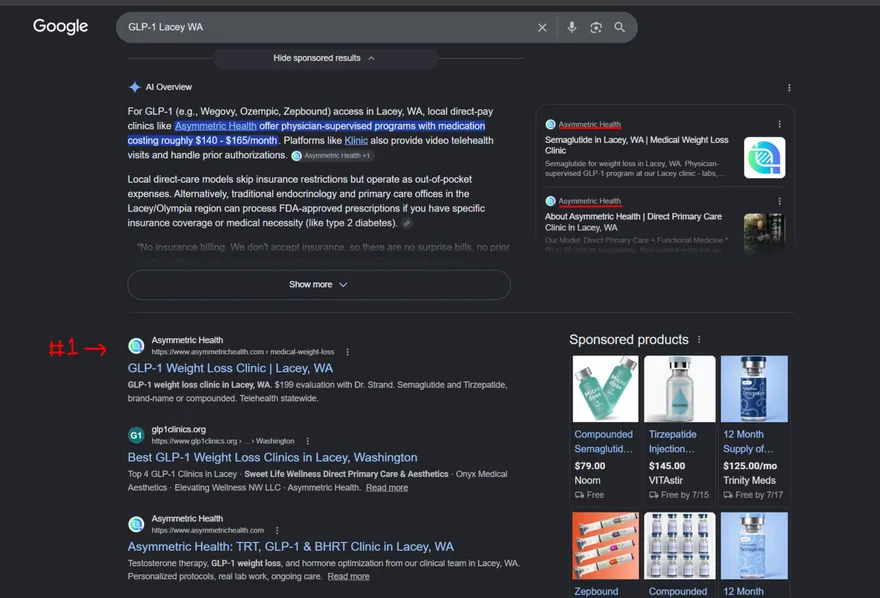
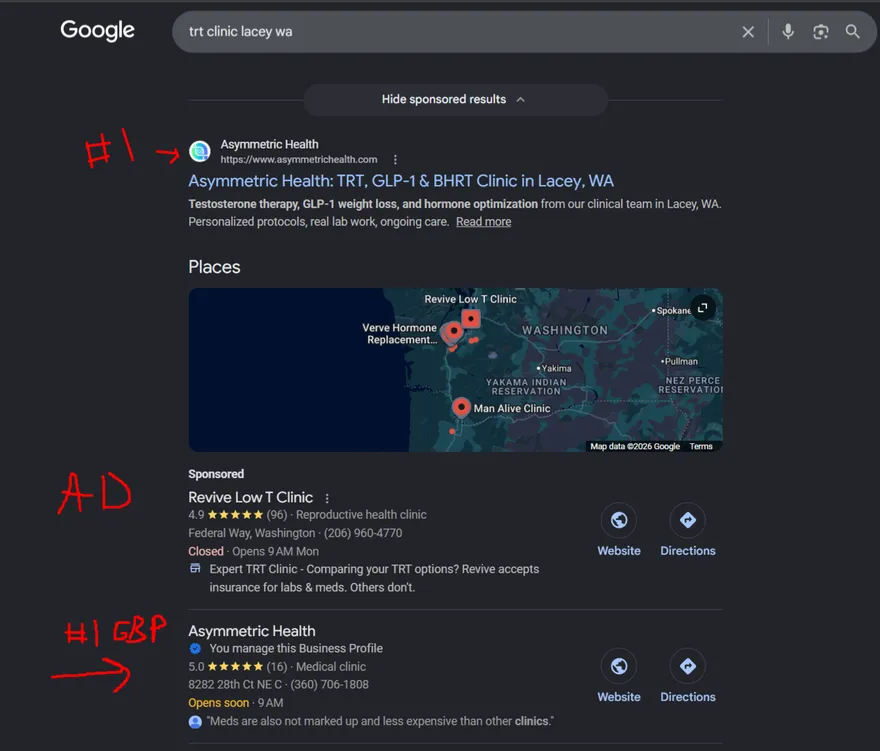
Our anchor healthcare client is Asymmetric Health, a physician-led Direct Primary Care clinic in Lacey, WA specializing in TRT, GLP-1-assisted medical weight loss, and BHRT. It came to us losing local patients to national telehealth.
Two months after we rebuilt the site and launched its healthcare SEO program, it was #1 organic for its priority searches, cited first by Google's AI Overview, and at the top of the Map Pack at 5.0 stars. Different state, same fight every California practice is in: systems above you, telehealth ads on top of you, and a winnable layer underneath both.
Time to #1
2 moOrganic rankings
#1AI Overview citation
1stGoogle map pack
Top 3Healthcare SEO across California: Southern California, the Bay Area, and the Central Valley.
Twelve markets, three very different fights. Which hospital systems own the organic results, how the payer mix splits, which languages the patients search in, and how fast the CPCs burn all change as you move down the coast and into the Valley. Click into your city for the local market breakdown.
The specialty-clinic capital of the country, wedged between hospital systems.
Cedars-Sinai, UCLA, Keck, and Kaiser own the citywide results, so independents win Los Angeles neighborhood by neighborhood. San Diego sorts into four systems with the West Coast's largest TRICARE population filling the seams. And the cash-pay corridors of Beverly Hills and coastal Orange County shop for physicians like they shop for everything else.
Tech patients with the highest digital expectations in American healthcare.
UCSF, Stanford, and Kaiser hold the organic high ground, leaving the most valuable slice in the country: PPO-covered tech workers who read every review and expect online booking. The multilingual opportunity is huge and barely contested, from San Jose's Vietnamese community to the Cantonese-searching Sunset.
Shortage markets where SEO decides what fills the schedule.
Fresno and Bakersfield run some of the lowest physician-to-patient ratios in California, so a practice that ranks shapes its own payer mix instead of taking what the referral stream sends. Sacramento adds a four-system capital with a CalPERS-stable patient base. Competition is thin; SEO compounds fast here.
Patient Search Demand Across California, City by City
Monthly Google searches for doctor queries that name the city, from the Semrush US database, July 2026. City-modified searches are the floor: specialty searches and “near me” queries stack on top of these counts. Click a bar for that city’s full market breakdown.
Top query: "eye doctors in bakersfield ca"
Top query: "eye doctor fresno ca"
Top query: "foot doctor san jose ca"
Top query: "cherie nabeta doctor sacramento ca"
Top query: "ear nose throat doctor los angeles ca"
Top query: "ear nose throat doctor san diego ca"
Top query: "foot doctor in riverside ca"
Top query: "doctors in long beach ca"
Top query: "foot doctor oakland ca"
Top query: "ent doctor in san francisco ca"
Top query: "family doctor irvine ca"
Top query: "doctors in anaheim ca"
Source: Semrush US database, fetched July 2026. Each bar counts monthly Google searches for doctor queries that include the city name. Specialty and "near me" searches add to every total.
Local SEO, SEO, AI search, website design, and Google Ads for California doctors.
Five disciplines, one bundled monthly program. Every one of them gets re-tuned for the market it runs in, because healthcare SEO in California means something different in a Beverly Hills dermatology corridor than it does in a Fresno shortage market.
Service
Local SEO for California Doctors
The Map Pack ranks on proximity, profile completeness, and reviews, where a Cedars-Sinai or UCSF logo carries none of its organic authority. Local SEO for California doctors starts with a full Google Business Profile rebuild, healthcare-directory citation cleanup, and review velocity that is never gated or incentivized. Where practices stack twenty floors deep in one tower, the local pack is where booking happens.
Learn more →
Service
SEO for California Doctors
Healthcare SEO for California practices targets what patients search before booking: condition plus neighborhood, "best dermatologist near me", insurance questions, and the Spanish, Vietnamese, and Chinese-language queries most competitor sites never answer. That means service and condition pages with real clinical depth, Physician and MedicalBusiness schema, and content structured for extraction. The systems own the citywide head terms; you own everything underneath.
Learn more →
Service
AI SEO for California Doctors
AI SEO for California doctors is about getting cited when Google's AI Overview, ChatGPT, and Perplexity answer by naming specific practices. Those citations come from clean indexable HTML, declarative content, comprehensive schema, and a review profile the engines can verify. Most California practice sites run on page builders and are nearly invisible to AI extraction, which makes this the least crowded opportunity in the state.
Learn more →
Service
Medical Website Design for California Practices
Hand-coded Astro builds, no WordPress, no page builders, tuned for the patient-booking flow: 99+ PageSpeed, click-to-call and book-online on mobile, credentials and reviews above the fold, and condition pages that read like a physician wrote them. California patients hold the highest digital expectations in the country. A slow practice site here is a referral to a competitor.
Learn more →
Service
Google Ads and PPC for California Doctors
PPC for California doctors fills the schedule while the SEO compounds, and in LA, San Francisco, San Jose, and Irvine the CPCs are high enough that sloppy targeting burns budget fast. We run Search on condition-plus-neighborhood queries, tight geo-targeting around where your patients actually live, and Spanish-language ad groups where the market calls for them. Tracked to booked appointments, not click charts.
Learn more →
By specialty
California is the specialty-clinic capital of the country, and the program runs specialty-specific where it should. If you operate in the LA or Orange County cosmetic corridors, start with the plastic surgery marketing and dermatology marketing pages, which cover the review-depth and cash-pay dynamics those markets run on.
Sports-injury markets like San Diego and Sacramento map to the physical therapy marketing program, and proximity-driven clinics should read the urgent care marketing page before anything else.
Healthcare SEO in California: what practices ask before signing on.
By refusing to fight where they're strongest. Kaiser members book inside Kaiser, and the UC academic medical centers plus Cedars-Sinai, Sutter, Sharp, and Scripps win the citywide organic head terms because Google treats their domains as medical authorities.
They are far weaker in the Map Pack, which ranks on proximity, Google Business Profile completeness, and reviews, and weaker still on neighborhood-modified and condition-specific queries, because a hospital directory page about cardiology is not a page about being a cardiologist in Willow Glen.
The working strategy for healthcare SEO in California: a fast site with dedicated pages for each service line and each neighborhood the practice draws from, comprehensive schema, and a review system that keeps velocity up.
Google's AI Overview increasingly answers "best [specialty] near me" by naming specific practices with strong review profiles and extractable content. That citation slot is winnable by an independent practice; the systems' directory pages rarely occupy it.
Los Angeles, San Francisco, San Jose, San Diego, and Irvine run at the top tier: the densest physician competition in the country, the highest CPCs, and hospital systems publishing at scale.
Sacramento, Oakland, Long Beach, and Anaheim sit at the elevated tier, with real competition but thinner digital execution among the practices already there. Fresno, Bakersfield, and Riverside run at the moderate tier: physician-shortage markets where most competitor sites are templated WordPress builds and healthcare SEO compounds fastest.
The honest read: harder markets take longer to crack citywide, but even in LA the fight is neighborhood-sized. A Brentwood practice is not competing with all 3.8 million Angelenos' options; it's competing with the practices near Brentwood, and that fight is winnable everywhere in the state.
One monthly fee covers the full program: local SEO, organic SEO, AI search optimization, review generation, monthly reporting, and ongoing work. No per-service line items. Website design is a separate one-time build, and Google Ads is its own line because that spend goes to Google, not to us.
We quote per market and specialty, because healthcare SEO in California prices differently in Beverly Hills than it does in Bakersfield, and a plastic surgery practice faces different competition than a family medicine clinic.
Send your practice name and city and we'll quote against your actual market. Before any quote, you get the free California Healthcare SEO Report so you can see the gaps we'd be working on.
Yes, and in much of California it's the least contested ranking opportunity available.
Medi-Cal covers roughly a third of the state, Spanish-language search demand is heavy from East LA to the San Joaquin Valley, San Jose holds the largest Vietnamese community of any city outside Vietnam, San Francisco's Sunset and Richmond districts search for care in Cantonese and Mandarin, and Fresno is home to one of the largest Hmong communities in the country.
Most practice websites in those markets are English-only, so the queries return directories and not much else.
The execution bar matters: hand-written pages reviewed by a fluent speaker, proper hreflang markup, translated Google Business Profile fields, and front-desk coverage in the language. A machine-translated mirror site reads instantly wrong to the patients it's supposed to book, and we won't ship one.
Yes, and we've done it. Telehealth pressure is sharper in California than anywhere because many of the companies are headquartered here and advertise to their own neighbors. The counter is the thing telehealth can't fake: a named physician at a physical address, real reviews, same-week availability, and content with actual clinical depth.
Our anchor healthcare client, a physician-led Direct Primary Care clinic in Lacey, WA specializing in TRT, GLP-1-assisted medical weight loss, and BHRT, was losing local patients to VC-funded national telehealth when it came to us.
Two months after the rebuild and SEO launch, the clinic was #1 organic for its priority searches, cited first by Google's AI Overview, and holding the top of the Map Pack at 5.0 stars.
The telehealth companies buy the ads at the top of the page. A local practice can own everything underneath them, which is where patients who want in-person care actually click.
In a shortage market, marketing doesn't decide whether your schedule fills. It decides what fills it. A Central Valley practice with no search presence fills its panel passively, and in Fresno and Kern counties that defaults heavily toward Medi-Cal managed care.
A practice that ranks for its highest-value service lines in the right neighborhoods shapes its own payer mix, grows the profitable lines deliberately, and builds the visible reputation that helps recruit physicians, which in the Valley is the real bottleneck.
It also does retention work. Valley families drive to LA or the Bay Area when a search convinces them there's no credible local option. Deep content about what you actually handle locally keeps patients who would otherwise assume they had to travel.
Ready to see where your California practice actually stands?
The free California Healthcare SEO Report covers your Map Pack positions, Google Business Profile health, review velocity, and whether the AI answers mention you. We show you the gaps before we quote anything.
Family-owned agency · Healthcare marketing for practices nationwide · In search since 1999